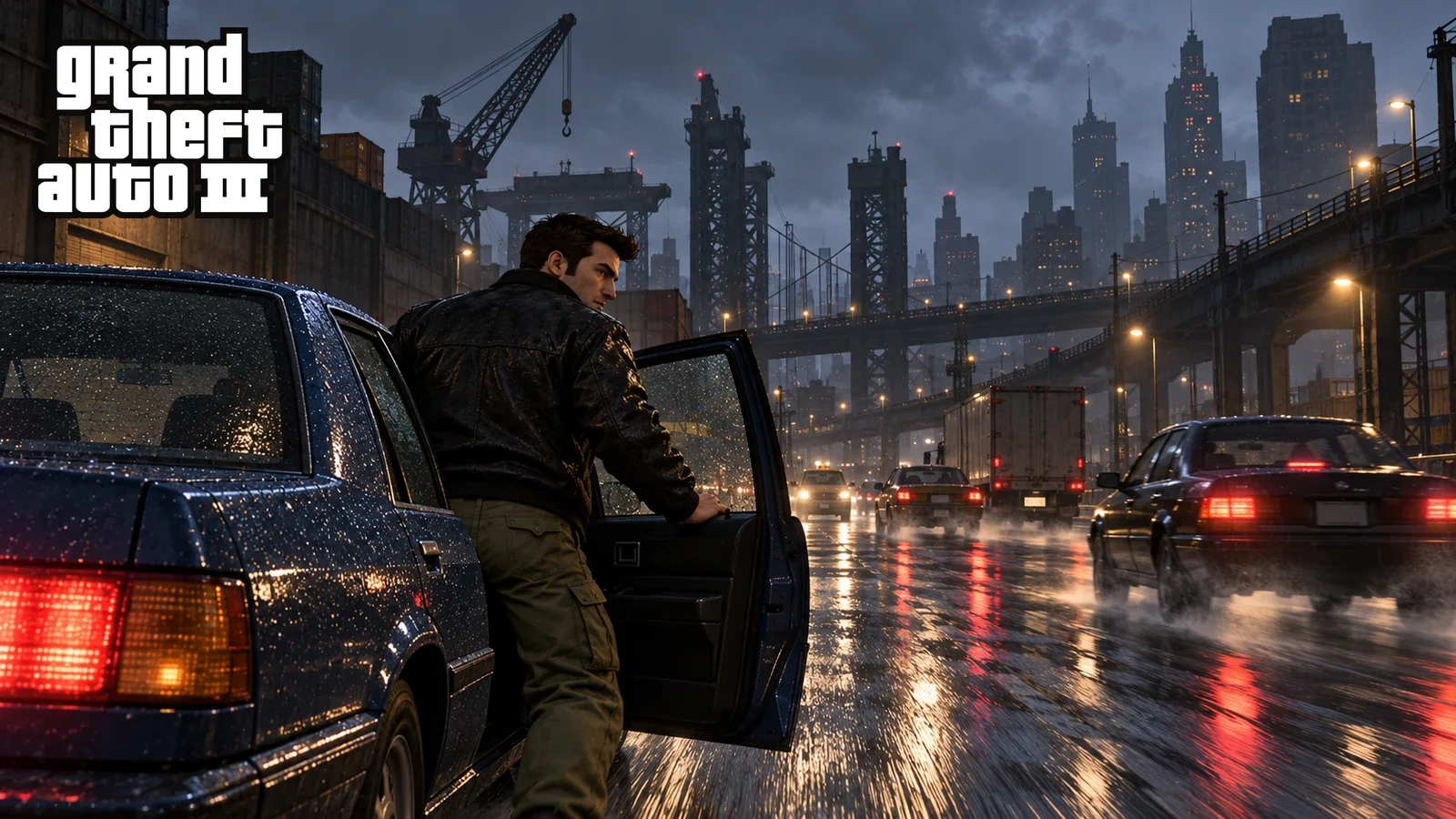
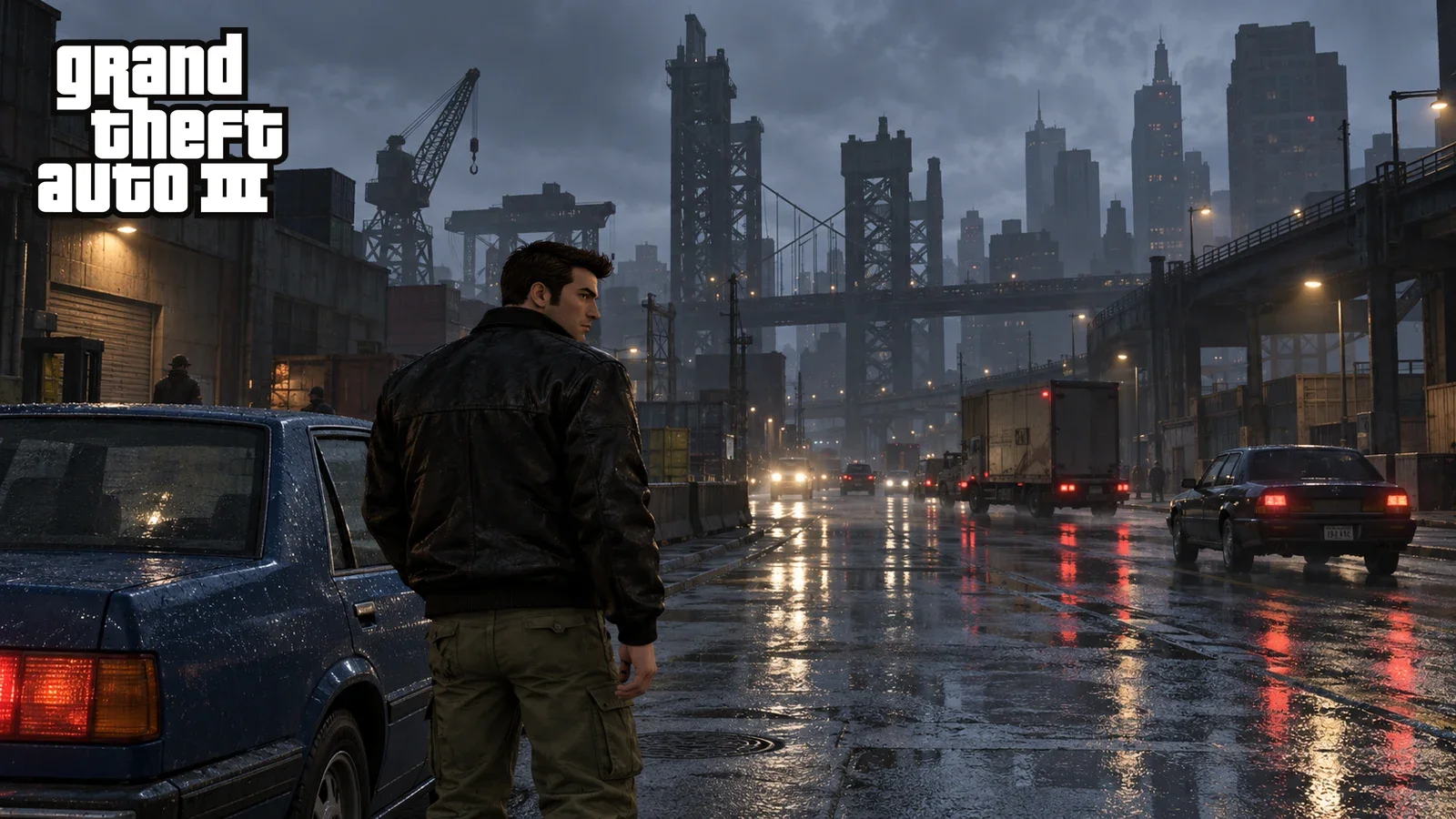
Grand Theft Auto III turns the city from a street grid viewed from above into a place seen from behind the protagonist. Its importance is not simply that buildings have depth. Driving, walking, missions, radio and police pursuit now occupy a continuous third-person space, making the trip between objectives part of the game's dramatic presentation.
This is a guide to the 2001 game and its later editions, with opening-story spoilers but no full ending walkthrough. The Definitive Edition preserves Claude's campaign while changing its presentation and controls; it is covered separately where those differences matter.
DMA Design and the people credited on GTA III
GTA III originally launched on PlayStation 2 in October 2001. DMA Design was the developer, before the studio adopted the Rockstar North name. Rockstar's tenth-anniversary announcement identifies the original release and its significance to the series.
The original PS2 manual credits name Leslie Benzies as producer, Aaron Garbut as art director, and Obbe Vermeij and Adam Fowler for technical direction. Design credits include Chris Rothwell, Craig Filshie, William Mills and James Worrall. The writing credits include James Worrall, Paul Kurowski and Dan Houser.
These are historical credits, not statements about anyone's present employment. They also show why 'who created GTA III?' has several valid answers depending on the role. Production, programming, environment art, animation and script work solve different parts of the same problem: making the player understand and move through a convincing city.
Claude's opening and the central characters
Claude is betrayed by Catalina during a robbery. After escaping a prison transport with 8-Ball, he begins taking work in Liberty City. The premise establishes both his vulnerability and the practical route forward: contacts introduce him to new jobs and criminal organizations.
The main cast includes Catalina, explosives expert 8-Ball, Salvatore Leone, Maria, Asuka Kasen and Kenji Kasen. Luigi Goterelli, Joey Leone, Toni Cipriani, Ray Machowski and Donald Love connect Claude to different parts of the city's underworld. The character reference documents those relationships.
Claude's silence changes the balance of the scenes. Other characters explain their demands, ambitions and suspicions while he provides the action. This is a different storytelling approach from Tommy Vercetti's outspoken personality in Vice City or Niko Bellic's conversations in GTA IV. It should not be mistaken for the absence of a plot.
Portland, Staunton Island and Shoreside Vale
Liberty City is organized around three major areas. Portland establishes the industrial and neighborhood scale of the opening; Staunton Island introduces a denser central-city identity; Shoreside Vale adds a different road and elevation pattern. Progress opens more of the map rather than giving immediate unrestricted access to every district.
The geography rewards learning more than the route to the next mission icon. Knowing where a bridge, tunnel, garage or safehouse sits can change the outcome of a pursuit. A road that looks direct on a map can be awkward in a damaged car or under heavy police pressure.
This Liberty City is not GTA IV's map. Both use a New York-inspired identity, but their layouts, boroughs and narratives belong to different versions of the setting. A GTA IV location guide therefore cannot be used to navigate Claude's city.
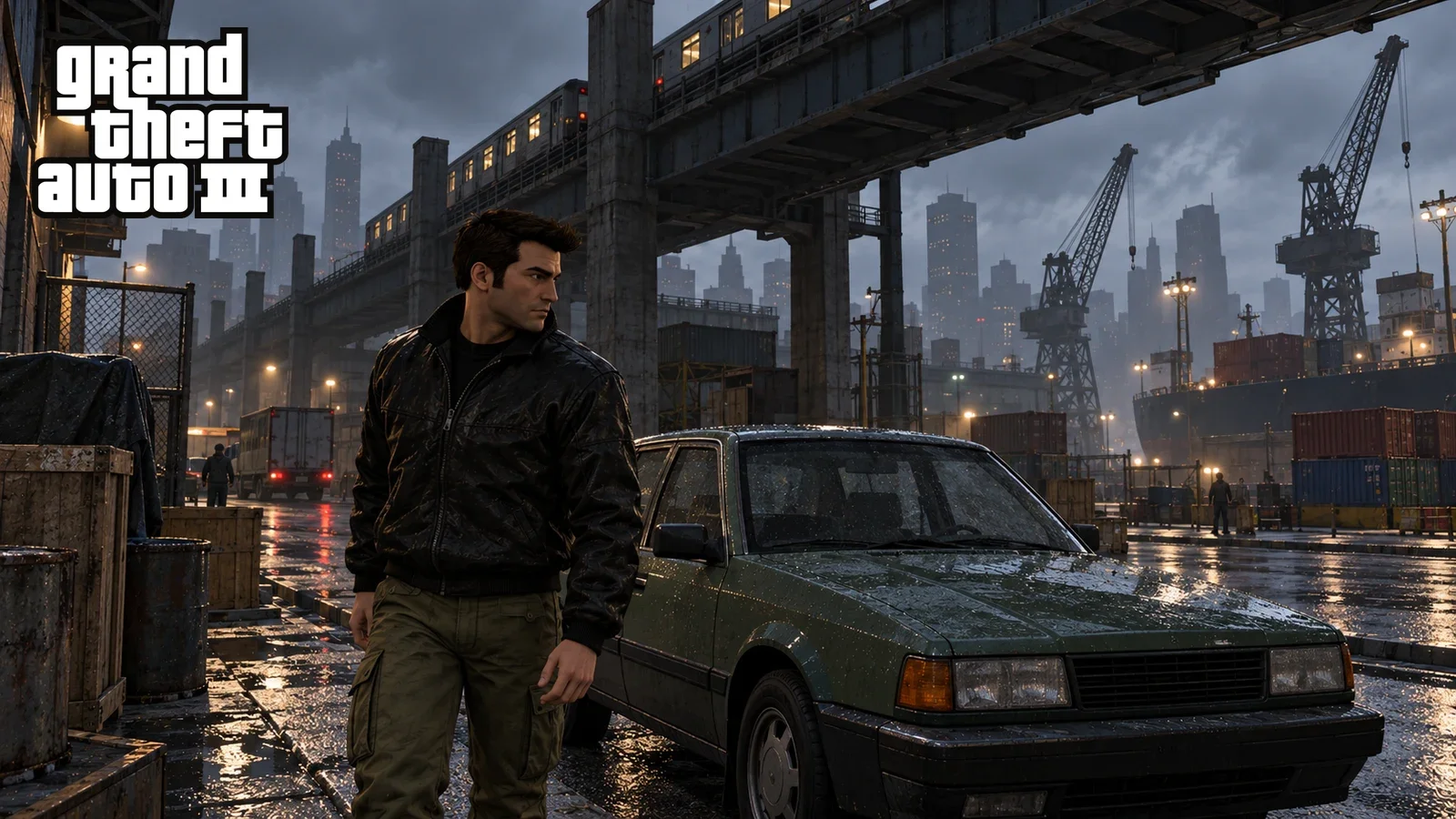
Missions and the open world between them
The campaign sends Claude through driving, combat, escort and timed objectives. Outside the main story, vehicle-based activities such as taxi, ambulance, fire and vigilante work offer different reasons to learn the road network. Hidden packages and stunt jumps encourage closer exploration.
For a first playthrough, separate mission preparation from the mission itself. Arriving with health, armor and a suitable vehicle can reduce the number of things that must go right after the objective begins. A large vehicle may withstand more punishment but be awkward in a narrow route; a quick car may be more fragile. The choice is situational rather than a universal ranking.
The original release also expects more navigation memory than modern GTA. Rockstar's support note on the missing in-game map confirms that the original PC/Mac editions do not provide the kind of pause-menu map a modern player might expect. That limitation should not be projected onto every later edition.
Assets, sound and the technical shift
A third-person view requires streets to work at eye level as well as from above. Building silhouettes, intersections, vehicles and pedestrians must remain legible while the camera moves. Radio adds continuity during long drives, while short encounters make the city feel active beyond the mission script.
This is design analysis, not a claim that NextPlayIntel has inspected Rockstar's source code. The visible experience demonstrates the interaction of world layout, streamed scenery, traffic and mission logic; it does not reveal every internal algorithm. Readers interested in those distinctions can use our GTA technology and assets explainer.
Original releases, mobile ports and the remaster
GTA III expanded beyond PS2 to PC and Xbox, later reaching mobile devices and additional console distribution formats. A re-release of the old game is different from the 2021 Definitive Edition. Check the full product name before following graphics, controls or cheat instructions.
The Definitive Edition is part of the collection with Vice City and San Andreas. Its updated interface and presentation do not turn it into a new story starring a different Claude. It is also not a remaster of GTA IV. These distinctions are especially important when a store listing shortens a title to 'GTA Trilogy.'
For codes, use GTA III cheats by platform. For the earlier events involving Toni, read Liberty City Stories. Release order remains a straightforward way to experience the series' evolving controls and presentation without expecting every prequel to behave like the game it precedes in the fictional timeline.
Sources & verification
Sources last verified on . This article covers published information, not hands-on testing.
Editorial & update notes
AI-assisted research and writing based on the linked references. This is not a hands-on review. Images are labelled AI-generated illustrations, not gameplay screenshots.