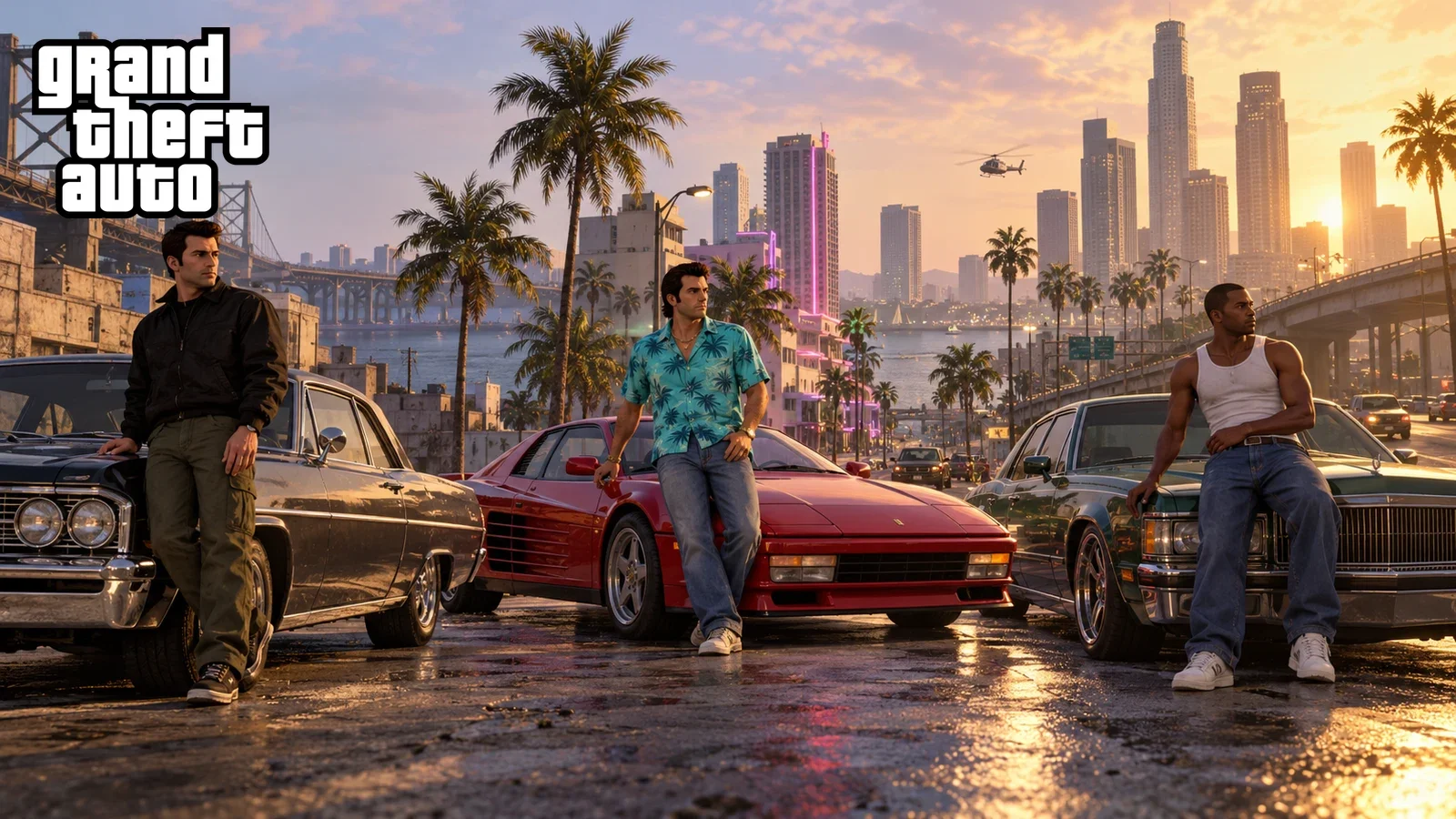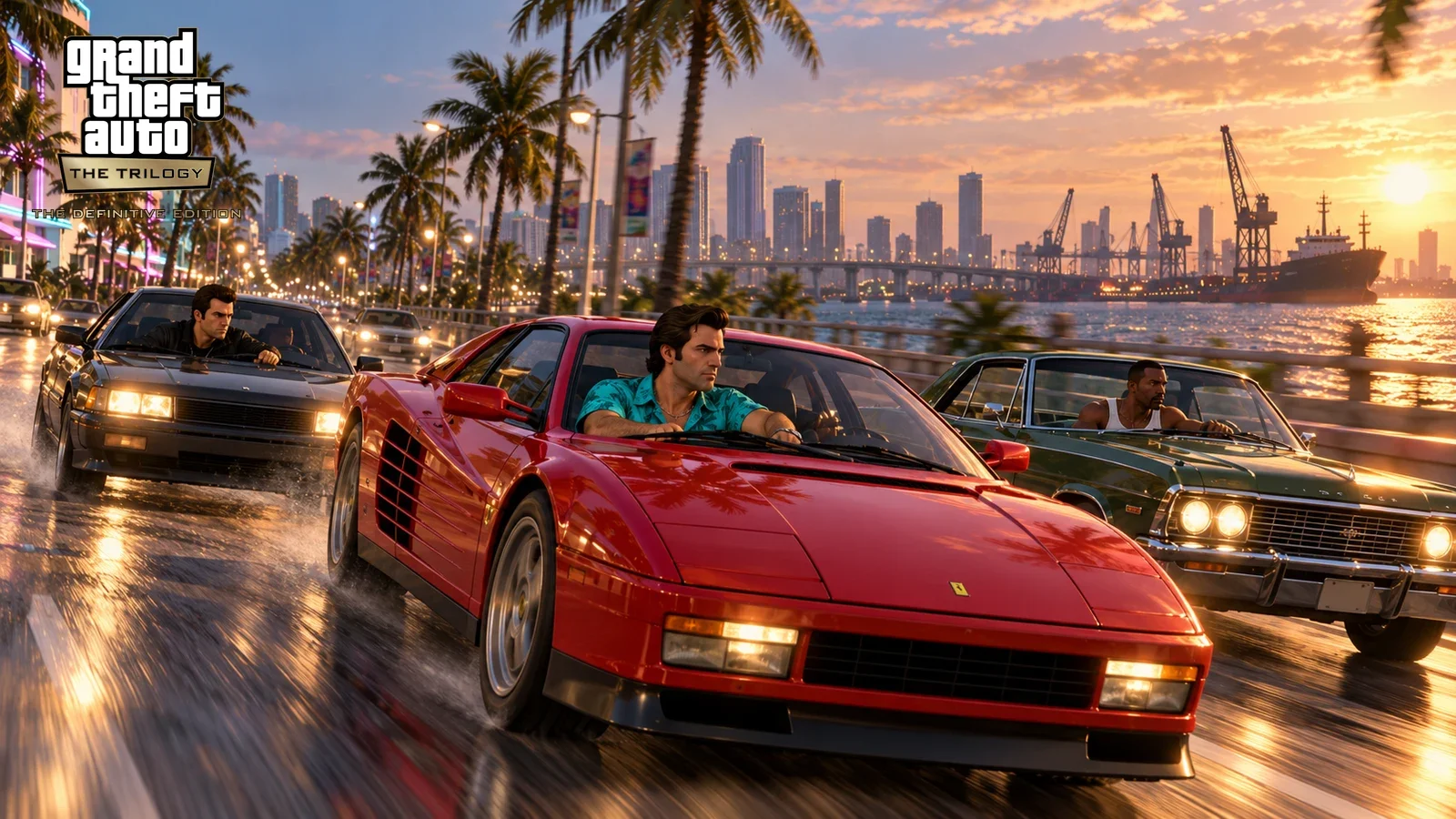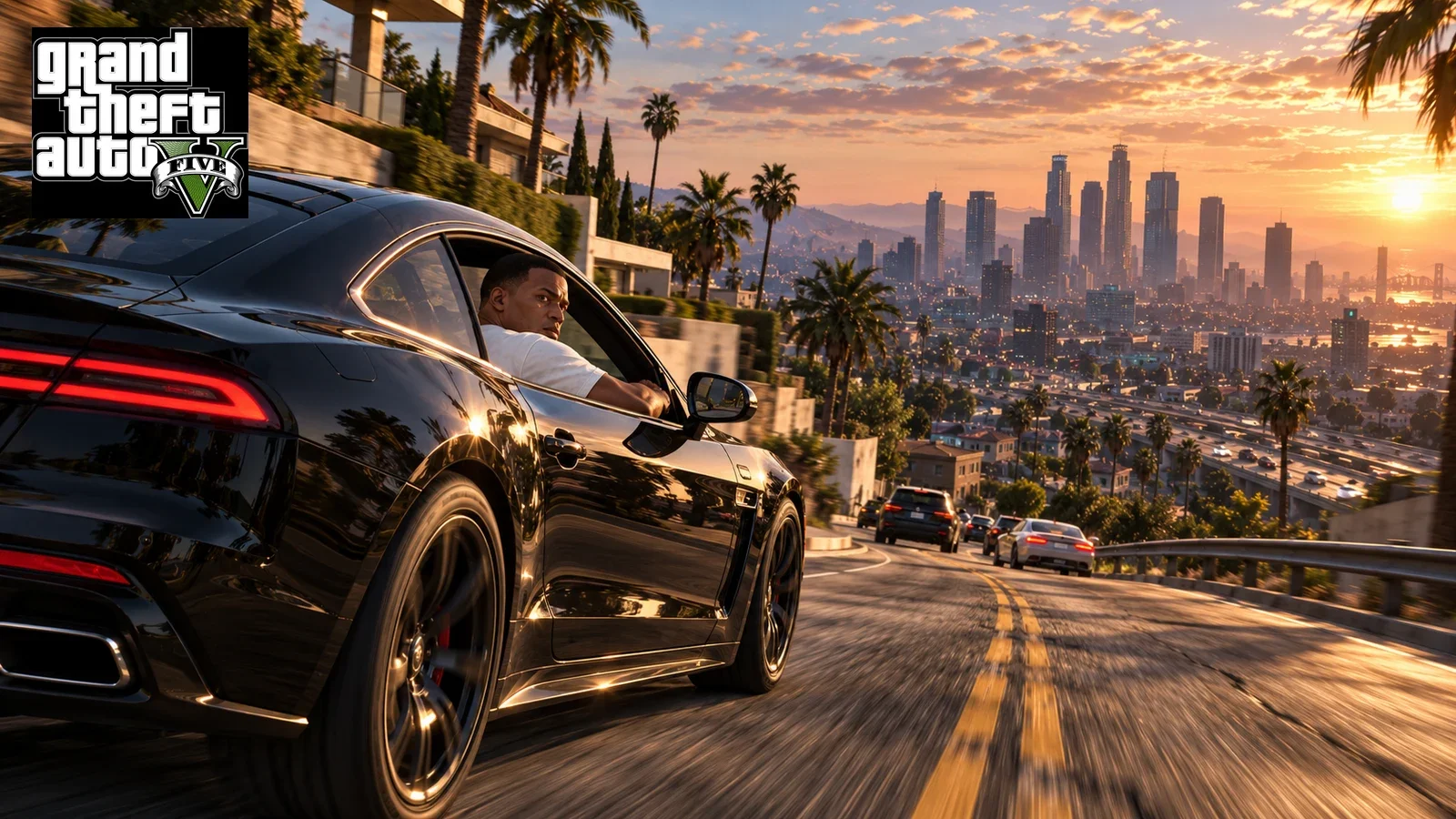
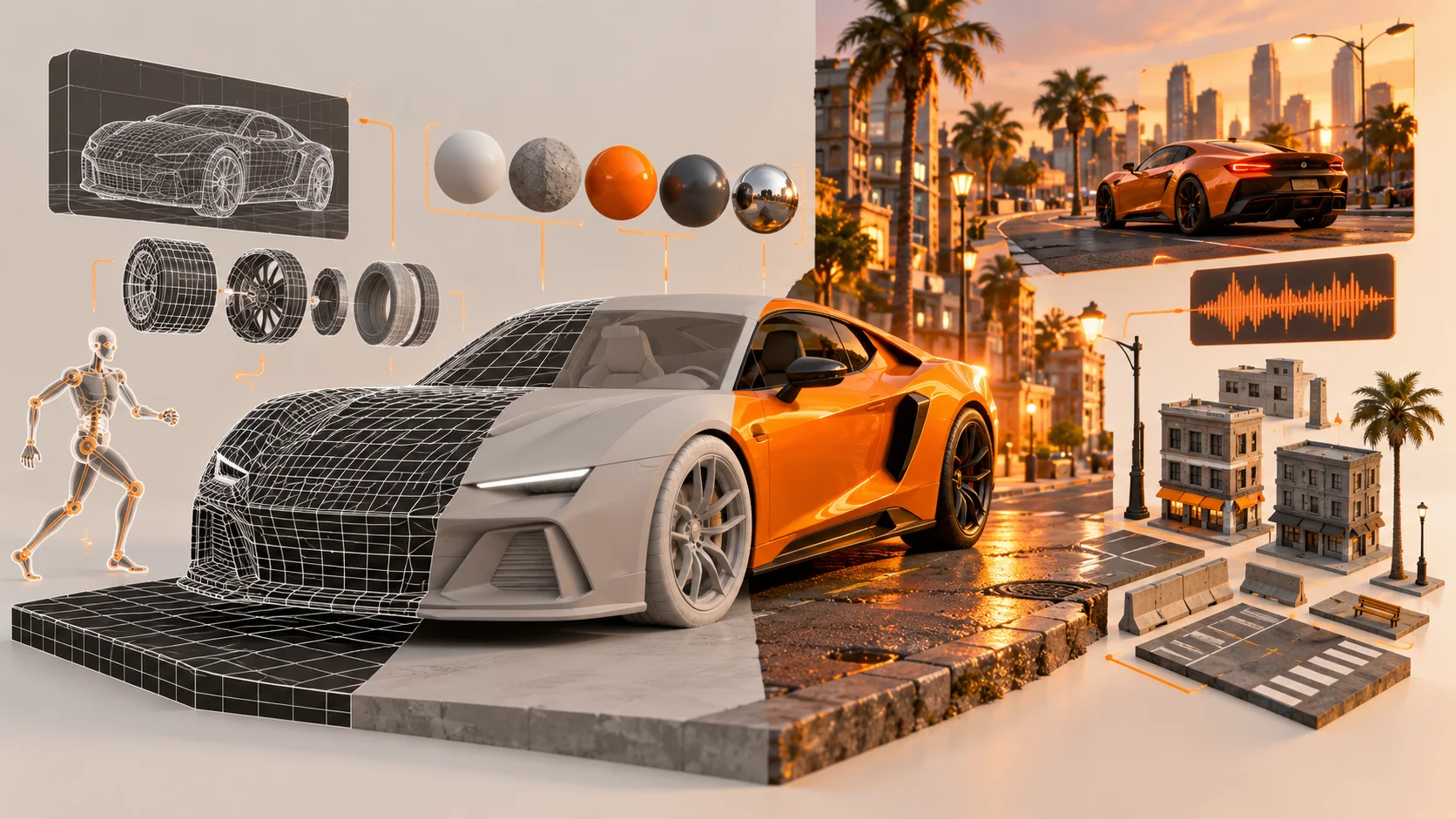
A GTA city looks like one continuous place, but a game has to construct that experience from many different kinds of data and software. The car in front of the player is geometry, materials, animation, sound and behavior. The street is a collection of visual objects, collision shapes, lighting and navigation information. The engine coordinates those pieces quickly enough for the world to respond to input.
Understanding GTA technology starts by separating three things: the engine that runs the game, the assets that describe its world, and the tools developers use to create those assets. Confusing them leads to claims such as an engine automatically producing an entire city, or a realistic-looking trailer proving every underlying simulation feature.
This article distinguishes documented Rockstar technology from general real-time graphics and game-development concepts. The educational examples explain how such systems work in principle. They are not a reconstruction of Rockstar's private source code, an inventory of GTA VI files or a claim that every technique described appears in every GTA edition.
What is a game engine?
A game engine is a collection of systems used to run an interactive world. It handles tasks such as drawing images, updating objects, processing input, playing sound and managing data. Depending on the project, it can include or integrate physics, animation, networking and tools for creating levels.
Consider a simple action: pressing a button to accelerate a car. The input must be interpreted. The vehicle's movement must be updated. Collisions may alter that movement. Wheel animation and sound must respond. The camera must show the result, and the renderer must produce a new image. If the experience is online, relevant state may also need to be communicated to other participants.
The engine enables these operations, but it does not decide everything about them. Designers choose behavior, artists create appearance and programmers implement or adapt the required systems. An engine name alone cannot tell you a game's quality, map size, responsiveness or final performance.
Which technology is documented in Rockstar's games?
RAGE, commonly expanded as Rockstar Advanced Game Engine, is Rockstar's proprietary engine technology. Rockstar's own technical Q&A describes an updated RAGE version containing graphics and physics technology, and explains how Euphoria works alongside it as a behavior system. That answer discusses Max Payne 3 and builds on behaviors used in GTA IV and Red Dead Redemption; it should not be stretched into a complete specification for GTA VI.
The original Vice City PC manual documents DirectX 9.0 and period-specific PC requirements. DirectX is a graphics and multimedia API, not the complete game engine. A requirements page, an engine credit and an audio-library credit answer different technical questions; they should not be treated as interchangeable.
There is also an important edition-specific exception to simplistic engine claims: Rockstar identifies Unreal Engine in the Definitive Edition trilogy adaptation. That does not mean every GTA uses Unreal Engine, and it does not establish the engine of a future title.
For GTA V Enhanced on PC, Rockstar explicitly documents ray-tracing features and support for AMD FSR and NVIDIA DLSS. These are confirmed features of that edition. A general claim about "GTA graphics" should specify the game, platform and edition before drawing conclusions from them.
Engine, editor and asset: the difference
The engine is the runtime foundation. An editor or content-creation tool is what a developer uses to author or inspect material. An asset is the resulting resource or data used by the game. A modeling application can create a mesh; an animation tool can author movement; an audio tool can prepare sound. The game then needs a way to import, organize and use the results.
These tools do not all have to come from one vendor. A studio can combine proprietary software, commercial applications and specialized utilities. However, saying that a tool is common in the industry is not evidence that Rockstar used it for a particular GTA character or environment.
What counts as a game asset?
An asset is broader than a visible 3D object. It can be a mesh, texture, material, animation clip, audio recording, particle effect, interface graphic, collision representation or a piece of structured gameplay data. Some assets are directly visible or audible; others exist to make interaction work.
A building illustrates the distinction. Its visible walls might be one resource, while a simpler collision shape prevents the player from walking through them. A navigation representation can help characters move nearby. A lower-detail version can be used at a distance. A sign on its front may reference a separate texture or material.
This is why an "asset count" without a definition is not very informative. Does one vehicle count as one asset, or do its textures, sounds, damage pieces and variants each count separately? Without access to a documented counting method, a precise total would suggest knowledge that the reporter does not have.
Meshes: the shape of the world
A mesh describes a surface through vertices, edges and faces. In a real-time scene, these surfaces represent objects such as cars, people and buildings. The visible silhouette is especially important: an object can have detailed surface color and still look wrong if its basic proportions are incorrect.
Textures, UVs and materials
A texture is image data that can supply information about a surface. It might provide color, small-scale surface variation or another property used by a shader. UV coordinates connect locations on a three-dimensional surface with locations in a two-dimensional texture, allowing the right part of an image to appear on the right part of an object.
A material describes how the surface should appear under lighting. Painted metal, rubber and glass do not respond in the same way. A material can combine multiple inputs to produce those differences. A normal map, for example, can alter the apparent surface orientation used in lighting without adding equivalent small geometric details to the mesh.
Imagine a generic game car. Its body panels need a different surface response from its tires. Its windows need to read as glass rather than gray plastic. Dirt and wear can help establish use, but excessive detail everywhere can obscure the overall shape. Realism is a coordinated result of geometry, materials, lighting and presentation rather than a single high-resolution image.
Rigging and animation: making a model move
A character mesh needs a controllable structure to move convincingly. A rig provides controls or a skeleton, and skinning connects the visible surface to that structure. Animation describes how those controls or bones change over time. Facial performance, clothing and accessories can introduce additional requirements.
An interactive character needs more than one convincing animation. Walking must transition into stopping, turning or another action. The game needs to select and blend suitable movement while maintaining responsiveness. If the animation looks beautiful but responds too slowly, it can undermine the feeling of control.
Motion capture can provide recorded performance, but recorded movement still needs processing and integration. A capture session does not automatically solve every interaction between a character, the environment and player input. For example, uneven ground and different object positions create situations that a single fixed recording cannot cover by itself.
Physics, ragdolls and Euphoria are related but distinct
Physics simulation concerns how objects move and interact under modeled rules. Collision detection determines when shapes intersect or contact one another. A ragdoll represents a body through connected physical parts, allowing it to respond to forces and constraints instead of following only a fixed animation.
A behavior system can add active responses to that physical situation. Rockstar's Q&A explicitly distinguishes Euphoria's behavior role from the graphics and physics technology in RAGE. Describing Euphoria as the entire GTA engine would therefore collapse separate systems into one inaccurate label.
The distinction is useful even without access to implementation details. A stumble can involve authored animation, physical response and rules about how the character tries to recover. The final motion may look seamless, but that does not mean there is only one subsystem responsible for it.
Streaming: why a whole city need not be loaded at once
An open-world game has limited memory and storage bandwidth. It cannot simply treat every nearby and distant object as equally important at all times. Streaming is the broader idea of bringing relevant data into memory and releasing or reducing data that is less immediately needed.
Texture streaming is one specific example. Epic's public documentation describes a system that adjusts texture resolution according to what the scene needs. That is an accessible explanation of the principle, not a statement that RAGE uses Epic's implementation.
Movement speed makes this challenging. A player walking through a neighborhood and a player driving quickly toward it create different demands on the loading system. The game must anticipate enough of the next area to avoid visible disruption while preserving resources for what is already on screen.
Level of detail, mipmaps and culling
Level of detail, often shortened to LOD, means using an appropriate representation for an object's importance on screen. A distant object may use a simpler mesh or other reduced representation. The goal is to spend resources where differences are visible instead of drawing every object as though it were directly in front of the camera.
Textures can also have reduced-resolution versions called mipmaps. Epic's texture-streaming documentation describes these precomputed image levels and how a streaming system selects detail within its memory budget. Texture resolution changing with distance is therefore not automatically a bug. This is an explanation of the principle, not a claim that RAGE uses Epic's implementation.
Culling avoids work on things that do not need to be drawn, such as objects outside the relevant view. Occlusion handling can account for things hidden behind other objects. These concepts do not mean the world disappears from the game's logic whenever the player looks away; rendering visibility and gameplay state are separate concerns.
Visible pop-in occurs when a change in representation or availability becomes noticeable. Its cause can vary. It is not enough to see one object appear late and conclude that the graphics card is solely responsible; content settings, storage, memory, engine behavior and the edition itself may all be relevant.
Lighting, reflections and ray tracing
Lighting helps establish time, weather, depth and material identity. A surface's color alone cannot explain why it looks warm at sunset, flat in shade or reflective after rain. The rendered image depends on how the game approximates or calculates illumination and how the material responds.
Ray tracing follows modeled rays to help calculate particular lighting effects. It is not a single switch that makes every part of a game physically exact. A game can use ray tracing for selected effects while using other methods elsewhere. The exact feature list matters more than the label by itself.
Rockstar's GTA V Enhanced PC announcement identifies ray-traced ambient occlusion and global illumination on PC, alongside ray-traced shadows and reflections previously introduced on PS5 and Xbox Series X|S. These statements concern that release and those features, not a universal specification for every GTA platform.
GTA V Enhanced: launch features versus later updates
The distinction between an edition and its patch level matters. Rockstar's Title Update 1.70 notes document March 2025 Enhanced fixes involving underwater frame rate, ray-traced rotor shadows, DLSS and video-memory issues. These are specific maintenance records, not evidence that every configuration suffers the same problem today.
Rockstar's Title Update 1.71 notes also record an option for high-resolution ray-traced reflections. A launch-day comparison can therefore miss settings introduced later. A useful benchmark needs the edition and patch as well as the GPU and resolution.
Upscaling and frame generation are not the same thing
Upscaling reconstructs an output image from a lower internal rendering resolution, using a method that depends on the technology involved. Frame generation produces additional displayed frames between rendered ones. These techniques can improve presentation or performance characteristics, but they solve different problems.
Rockstar confirms support for AMD FSR and NVIDIA DLSS in GTA V Enhanced. NVIDIA's August 2025 GTA V Enhanced announcement discusses DLSS 4 Multi Frame Generation. It identifies Multi Frame Generation for RTX 50 Series hardware and Frame Generation for RTX 40 Series hardware. This does not mean every GPU supporting DLSS Super Resolution supports those frame-generation modes.
A displayed frame-rate number should not be read as a complete description of input response. Generated frames do not by themselves imply that game simulation and input are being updated at the same increased rate. Image stability, latency, compatibility and the underlying rendered frame rate all remain relevant when evaluating the result.
Audio assets and the sound of a city
Audio assets can include dialogue recordings, vehicle sounds, impacts, footsteps, ambient loops and music. Their placement and playback rules are as important as their individual quality. A sound must occur at the right time, with an appropriate sense of location and priority, to support the scene.
A GTA soundtrack also includes creative work that is distinct from audio software. The original GTA V score was composed by Tangerine Dream, Woody Jackson, The Alchemist and Oh No, documented in Rockstar's joint event announcement with Film at Lincoln Center. Knowing the composers does not identify the runtime audio engine, and an audio-library credit would not tell us who wrote the music.
GTA V example: why a customized car is more than one model
Rockstar's GTA V manual identifies Los Santos Customs as a place to change wheels, paint and body kits. That observable feature makes a useful case study for understanding assets without accessing proprietary game files.
A wheel is geometry with a surface appearance, but the game also has to position it correctly and make its rotation agree with the vehicle's movement. A paint choice changes appearance without necessarily requiring a completely new car shape. A body-kit choice changes visible geometry. These are different classes of content change even though the player selects them within one customization activity.
The technical interpretation is that a customizable vehicle needs coordination between visible parts, material choices and gameplay state. This article does not claim a particular GTA file format, object hierarchy or number of models. Those details cannot be established from the customization menu alone.
The same reasoning helps explain why a good-looking standalone car render is not equivalent to a working GTA vehicle. In a game, the object must remain coherent under movement, lighting, collision and interaction. Our orange car illustration explains geometry and surface stages; it is not a recreated or extracted Los Santos Customs asset.
PlayStation, PC, mobile and Steam: what a comparison should show
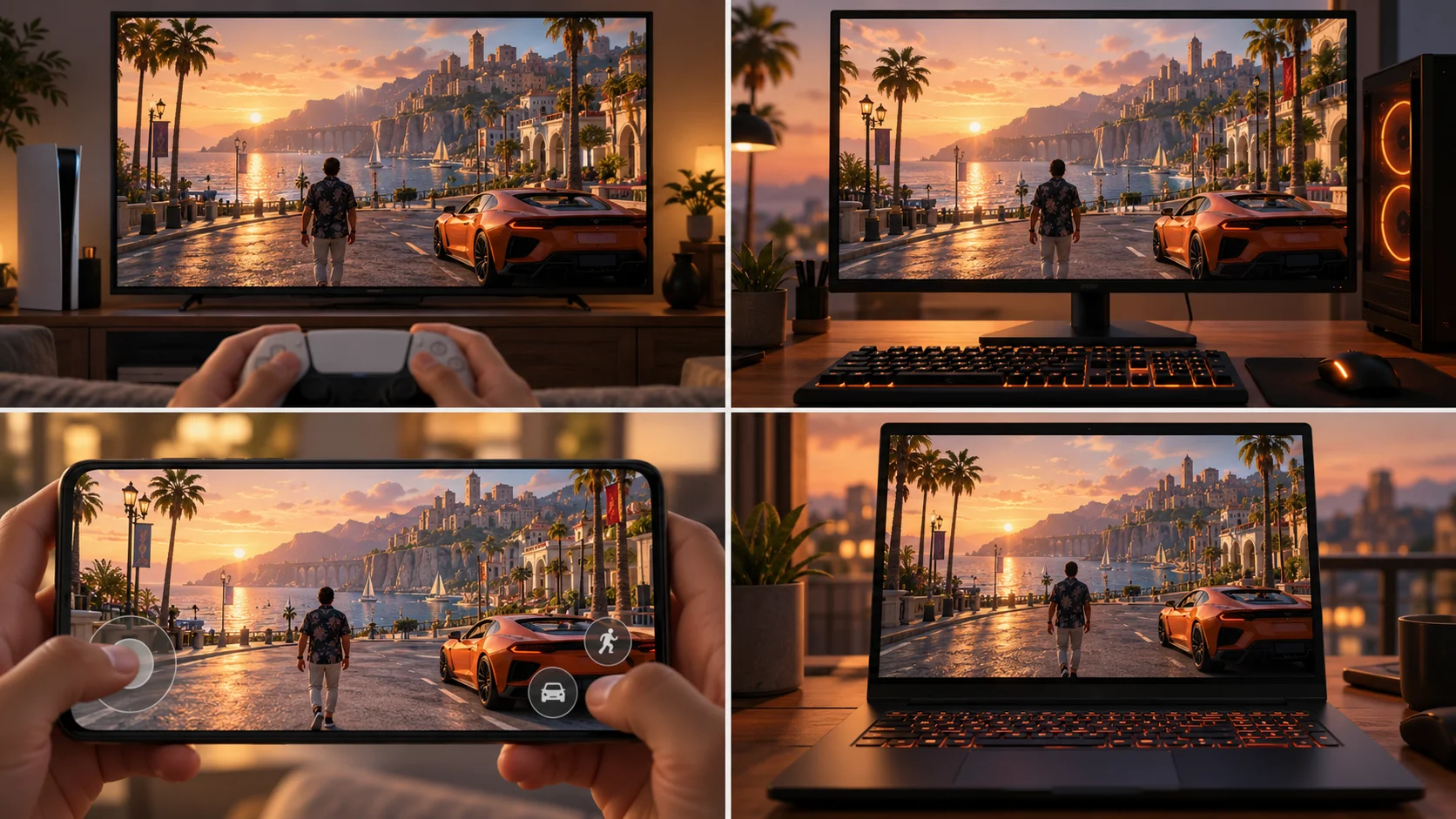
AI-generated screenshot-style concept art. Fictional scene and interfaces, not actual GTA screenshots or a platform graphics comparison. The phone view does not imply GTA VI mobile availability; Steam is a PC storefront.
A console release, a PC release and a mobile adaptation can differ in controls, supported features and presentation. PlayStation identifies a console family; PC describes a hardware and software platform; mobile covers devices and operating systems with their own requirements. Steam is a PC storefront and distribution platform, not a separate graphics engine or console. A PC game bought through Steam does not become a distinct visual generation merely because of the store used to obtain it.
The four-panel illustration accompanying this section uses a fictional city, car and character to show those viewing contexts. Its console panel is relevant to the idea of living-room PlayStation play, its desktop and laptop panels illustrate PC use, and its phone panel illustrates touch controls. It is AI-generated concept art, not a recreation of verified screenshots, a fidelity comparison or evidence that GTA VI exists on mobile or Steam.
Real comparisons need the same game and equivalent scenes. They should name the edition, patch, platform, resolution and visual settings, and distinguish a native mobile port from a video streamed to a phone. Remote play can display a game on a mobile screen while the game itself runs on another machine; that is different from a native mobile release. A still image alone may not reveal which arrangement is being used.
For an example of a documented mobile adaptation, Take-Two announced Liberty City Stories for iOS. That specific announcement supports that particular game's mobile history. It should not be generalized into a claim that every GTA is available natively on phones. For GTA VI's announced platforms, use the current official listing rather than an illustrative device mockup.
What we can and cannot conclude about GTA VI
Rockstar's official GTA VI site establishes the announced setting, characters, platforms and current release information. It is the appropriate starting point for confirmed promotional facts. A technology article should not convert visual impressions from that material into an invented complete engine specification.
Claims about an exact internal RAGE version, total polygon count, all buildings being enterable, a precise asset total or a universal performance target need direct supporting evidence. None of those claims is necessary to explain why an open world is technically complex. Leaving them unasserted is more informative than filling the gaps with confident numbers.
Frequently asked questions
Can an engine automatically create a game like GTA?
An engine supplies capabilities, but the finished experience requires content, design decisions, engineering, performances and testing. A city generator or an asset library would still leave questions about interaction, narrative, progression, usability and consistency.
Does a more detailed model always produce better graphics?
No. The result depends on how geometry, materials, lighting, animation and camera presentation work together. Excess detail can consume resources without producing a meaningful visible improvement, especially at a distance.
Are these illustrations real GTA assets?
No. They were generated for this editorial series and depict generic concepts. They do not show an extracted GTA vehicle, an official map or a real Rockstar development tool. Their purpose is to make the explanations easier to understand.
Does this article include hands-on performance testing?
No. Confirmed edition features are linked to their announcements, and the remaining sections explain general technical principles. Performance conclusions would require a named hardware configuration, settings, test method and reproducible measurements.
Further reading
For the games behind these technical changes, see our GTA series guide. For the studios and production credits, read who makes GTA.
Research note: This is an AI-assisted, source-based explainer. Historical claims are tied to the named game or edition. Interpretations and general technical explanations are distinguished from publisher-confirmed features; no hands-on testing was performed.
Sources & verification
Sources last verified on . This article covers published information, not hands-on testing.
- technical Q&A
- Vice City PC manual
- Unreal Engine in the Definitive Edition trilogy adaptation
- public documentation
- GTA V Enhanced PC announcement
- Title Update 1.70 notes
- Title Update 1.71 notes
- August 2025 GTA V Enhanced announcement
- Rockstar's joint event announcement with Film at Lincoln Center
- GTA V manual
- Liberty City Stories for iOS
- official GTA VI site