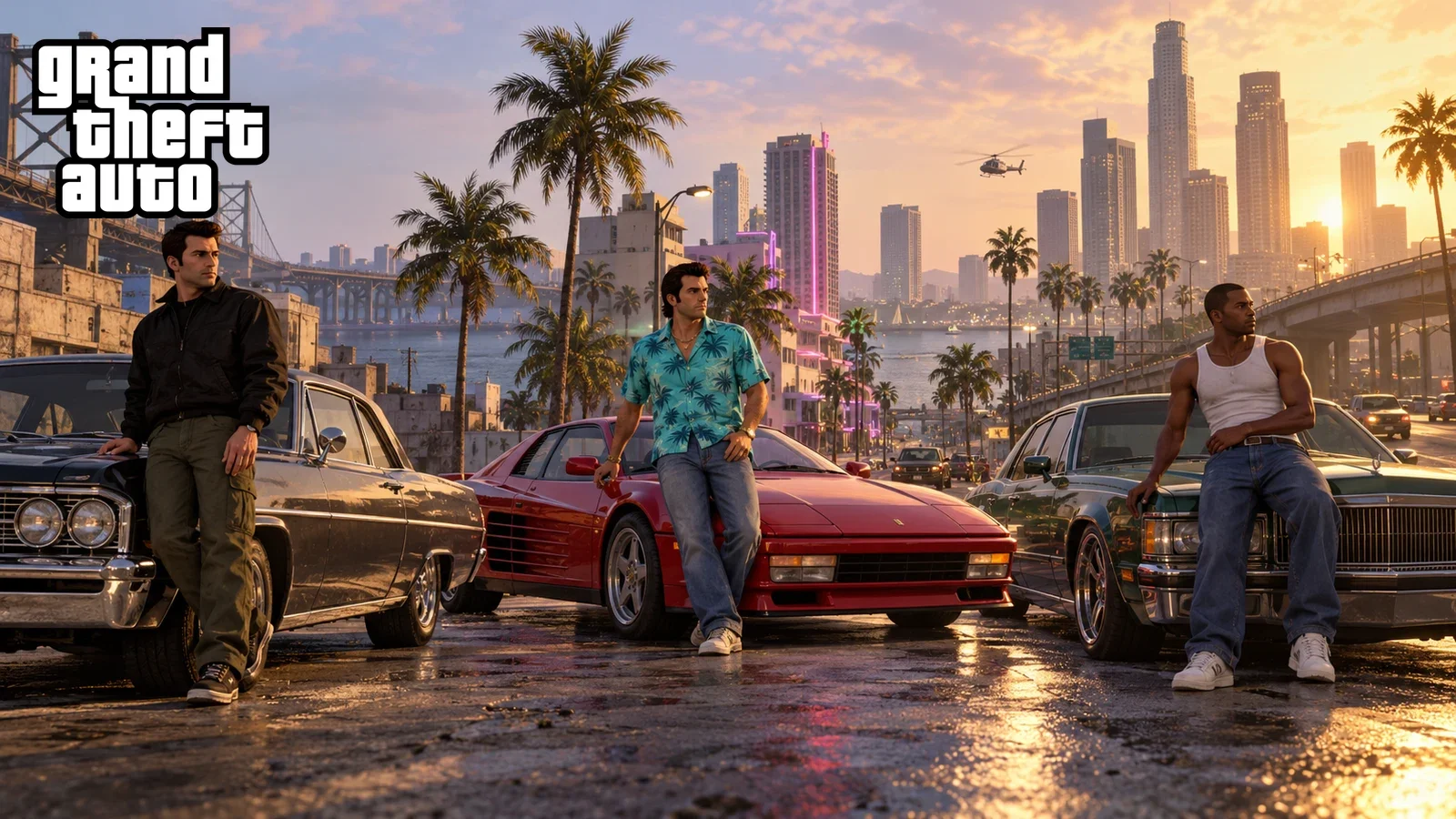
Grand Theft Auto, usually shortened to GTA, is a series of action-adventure games built around fictional cities, crime stories, driving and the freedom to explore. A GTA game gives you a character with a particular place in the story, then surrounds that character with streets, people, vehicles, businesses and activities that continue to matter outside the next mission.
This guide explains the series without major plot spoilers. It is a researched introduction, not a hands-on review or a walkthrough. Release years below refer to a game's first release, rather than every later port, remaster or platform edition.
What does GTA stand for, and what kind of game is it?
GTA stands for Grand Theft Auto. In the context of the games, the name identifies a crime-fiction franchise rather than a pure car-racing series. Driving is important, but so are on-foot movement, combat, conversations, missions, exploration and the way the world responds to a player's actions.
The term open world means that much of the environment can be traversed as a connected space. It does not mean every building is accessible, every activity is available immediately, or every mission can be completed in any way imaginable. A game can have a large open map while still using tightly directed missions, progression locks and story-specific restrictions.
Think of the experience as three overlapping layers. The story supplies characters and objectives. The city supplies geography and atmosphere. The systems supply traffic, pursuits, movement, damage, animation and other reactions. The exact balance changes between entries, which is why an older GTA can feel very different from a newer one even when both feature cars and criminal protagonists.
What do you actually do in a GTA game?
The most recognizable activity is completing missions. These can introduce characters, establish rivalries, change a protagonist's circumstances or open new opportunities. A mission might involve travel, a chase, a confrontation or several stages in sequence. It is the structured part of the experience: there are conditions to meet, ways to fail and a point at which the game judges the task complete.
Between missions, exploration changes the pace. Players can learn roads, discover neighborhoods, encounter side activities and become familiar with landmarks. This makes geography useful rather than purely decorative. A shortcut becomes something a player remembers; a district acquires an identity through its streets, sounds and activities.
The wanted system is another defining idea. Criminal actions can bring law-enforcement attention, making the same streets a place to escape through rather than simply travel across. Its rules vary by game. A guide for one entry should therefore not assume that the same search behavior, hiding method or pursuit escalation applies to another.
The series also uses radio, fictional advertising and exaggerated institutions to build its tone. These elements often satirize consumer culture, entertainment, status and power. They are part of the storytelling environment, even when the player is not watching a cutscene. GTA is aimed at mature audiences; a colorful city or cartoonish incident does not make it children's entertainment. Check the rating for the particular release and region.
The GTA release timeline
These are release years, not the years in which the stories take place. The first game's 1997 release is documented in Take-Two's historical filing; later milestones are supported by Rockstar game pages and announcements linked below. Regional dates and subsequent ports can differ. The list includes expansions and a remastered collection rather than presenting them all as numbered sequels.
1997 — Grand Theft Auto.
1999 — Grand Theft Auto: London 1969 and GTA 2. London 1961 is a separate early London expansion.
2001 — Grand Theft Auto III.
2002 — Grand Theft Auto: Vice City.
2004 — San Andreas and Grand Theft Auto Advance.
2005 — Liberty City Stories.
2006 — Vice City Stories.
2008 — Grand Theft Auto IV.
2009 — The Lost and Damned and The Ballad of Gay Tony; Chinatown Wars.
2013 — Grand Theft Auto V, followed by GTA Online.
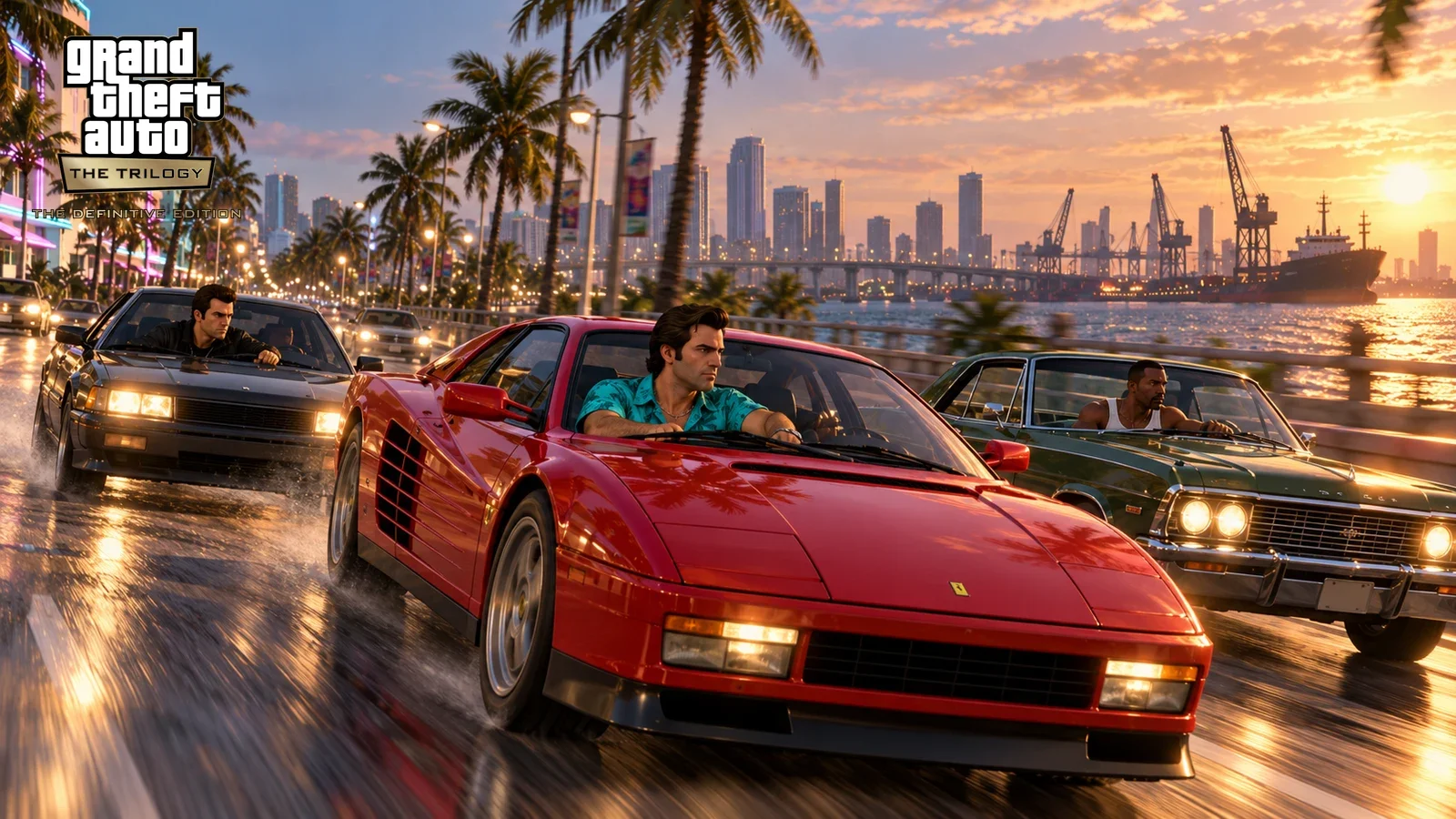
2021 — The Trilogy – The Definitive Edition, a collection revisiting III, Vice City and San Andreas.
2026 — Grand Theft Auto VI is scheduled for November 19, as checked on October 24, 2026. It is not yet released at the time of this article's verification.
Counting entries is less straightforward than this list might suggest. A compilation contains existing games. An expansion may tell a separate story without being a numbered sequel. A new console or PC edition may add technology and features while retaining the underlying campaign. An article claiming an exact number of GTA games should explain which of these it counts.
The early games: the idea before the modern camera
The original Grand Theft Auto established the series before the familiar modern third-person presentation. GTA 2 continued the early overhead approach. Their historical importance is that the franchise's identity did not begin with highly detailed faces or cinematic lighting: the relationship between movement, a city and player-directed disruption was already central.
The London releases are also a useful reminder that the franchise is broader than its numbered sequels. They belong to its early history and use a different geographical identity from the fictional American locations associated with many later games. Their presence in a chronology should not be confused with a claim that a modern GTA set in London has been announced.
GTA III: Liberty City becomes a three-dimensional stage
Grand Theft Auto III brought the series into its landmark three-dimensional era in 2001. Its protagonist is Claude, identified in Rockstar's own tenth-anniversary announcement. The change in viewpoint made streets, buildings and movement through a city central to the presentation in a new way.
The significance of that transition is easier to understand by thinking about navigation. In an overhead view, the player reads a street layout largely as a pattern. In a third-person city, they also read depth, sightlines, elevation and what is around the next corner. Camera behavior becomes part of the challenge of making the world understandable.
GTA III also offers a useful starting point for studying how the series' mission-and-exploration structure developed. It should be approached as an older design with its own conventions, not judged only by whether it contains every convenience introduced in subsequent releases. The original and the Definitive Edition are different editions, so technical advice needs to identify which one it concerns.
Vice City and San Andreas: setting becomes identity
Vice City and San Andreas are full entries rather than small additions to GTA III. Rockstar groups all three in The Trilogy – The Definitive Edition, but that packaging should not obscure their different stories and settings.
Vice City is associated with an exaggerated 1980s atmosphere. Its appeal as a setting comes from the way architecture, clothing, music and color contribute to a recognizable period identity. For readers studying game worlds, it illustrates how art direction can make an environment memorable without depending solely on geographical size. A street can communicate an era through a relatively small number of carefully chosen details.
San Andreas follows Carl Johnson, also known as CJ. Rockstar's official introduction describes his return to a Los Santos shaped by gangs, drugs and corruption. The game's broader journey gives the setting a different rhythm from a story concentrated around one compact city: urban neighborhoods and travel beyond them play different narrative roles.
The portable games and the Stories entries
The portable releases tell their own stories. Liberty City Stories follows Toni Cipriani returning to the Leone family's criminal world. Rockstar credits both Rockstar Leeds and Rockstar North and lists the original release in October 2005. Its later PS2 release belongs to the same game's platform history, not a new numbered sequel.
Vice City Stories takes place in 1984 and follows Vic Vance, a soldier whose life unravels after a bad decision. The change of protagonist and period gives the familiar city a different starting point. This is why a Stories title should not be mistaken for an extra chapter of Tommy Vercetti's campaign.
Chinatown Wars begins with Huang Lee bringing a family sword to his uncle Kenny in Liberty City. Rockstar lists Nintendo DS, PSP and mobile editions and credits Leeds and North. Its 2009 release demonstrates that the franchise continued exploring portable formats after GTA IV arrived on home consoles.
Grand Theft Auto Advance is a separate Game Boy Advance release with new missions in Liberty City, credited by Rockstar to Digital Eclipse. Together, these games show why a history limited to the numbered console releases misses a substantial part of GTA.
GTA IV and its two connected episodes
Grand Theft Auto IV focuses on Niko Bellic in Liberty City. The Lost and Damned and The Ballad of Gay Tony add stories centered on Johnny Klebitz and Luis Lopez. Rockstar's Complete Edition listing describes the three stories as interwoven.
This is a different expansion model from simply adding a new set of vehicles or repeatable activities. The city becomes a shared stage for separate perspectives. A reader can therefore understand the Complete Edition as a collection of connected narrative experiences, while still distinguishing the base campaign from its episodes.
GTA V: three protagonists and a different structure
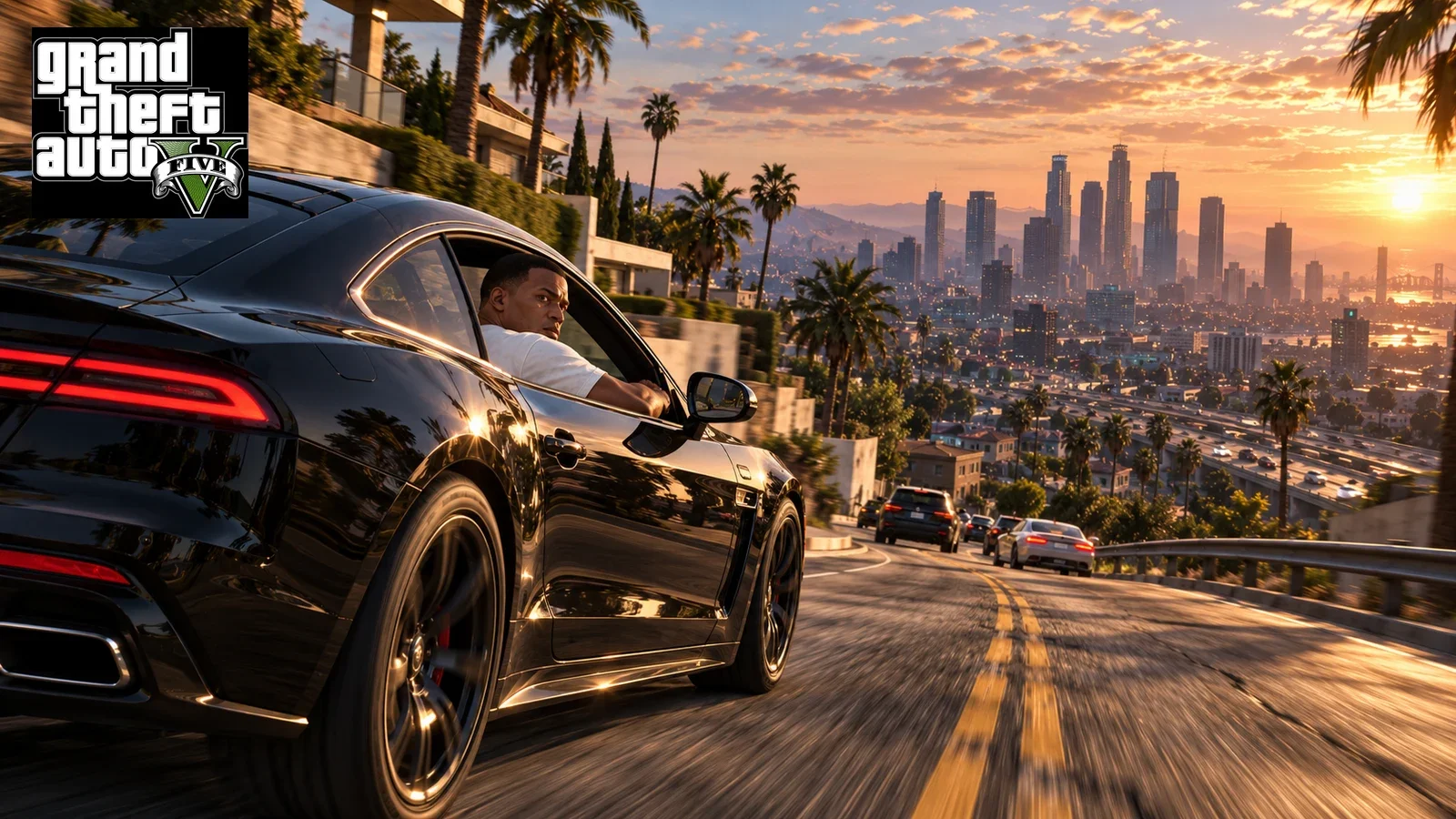
Grand Theft Auto V uses three playable protagonists: Michael, Franklin and Trevor. Rockstar's official game manual explains that some missions involve two or three of them and allow switching during the action.
The protagonists also have different special abilities: Michael slows combat, Franklin slows time while driving, and Trevor temporarily deals more damage while taking less. Character skill development is separate: improving Franklin's driving does not also improve Michael's. These distinctions are described in the manual, rather than inferred from promotional footage.
That arrangement changes how the story can be presented. Rather than placing every scene and relationship around one person's life, the campaign can connect different social settings and motivations. Character switching is therefore both a control feature and a narrative device. It should not be mistaken for three entirely separate games.
GTA V also exists in several hardware generations and PC editions. The campaign's identity can remain recognizable while rendering features, supported hardware and online compatibility change. Rockstar's Enhanced PC announcement explicitly distinguishes Enhanced players from Legacy players for online play. Simply saying that two people both own GTA V is not enough to establish that they can play together.
GTA Online is not the same thing as the story campaign
GTA Online is the multiplayer side of the modern series, organized around an online character, activities and continuing updates. The distinction matters for almost every practical question: progression, multiplayer access, account requirements, purchases and compatibility need to be tied to Online or Story Mode explicitly.
A campaign guide tells a reader how a designed story progresses. An Online guide may instead depend on a changing activity, an update or an event. That makes an Online article more sensitive to dates. A method that was relevant during one event period should not be presented as permanently current without verification.
Community roleplay is another separate topic. A roleplay server's rules, jobs and interfaces are not automatically official GTA Online features. Videos can make these experiences look similar to a new viewer, but their source and requirements are different. Always identify whether footage comes from a standard game, an official online mode or a modified community environment.
How GTA VI fits into the series
As of October 24, 2026, Rockstar's official GTA VI page lists November 19, 2026 and PlayStation 5 and Xbox Series X|S. Its story introduction names Jason and Lucia and places their criminal conspiracy in Leonida, including Vice City. Those are confirmed promotional details, not observations from a finished game played for this article.
Returning to a familiar city name does not by itself establish that an old map, protagonist or mechanic will return unchanged. Trailers and screenshots show selected material. They do not independently prove a complete list of enterable buildings, a final frame-rate target or every gameplay system. The official GTA VI listing remains the source for changing launch information.
Do you need to play the games in order?
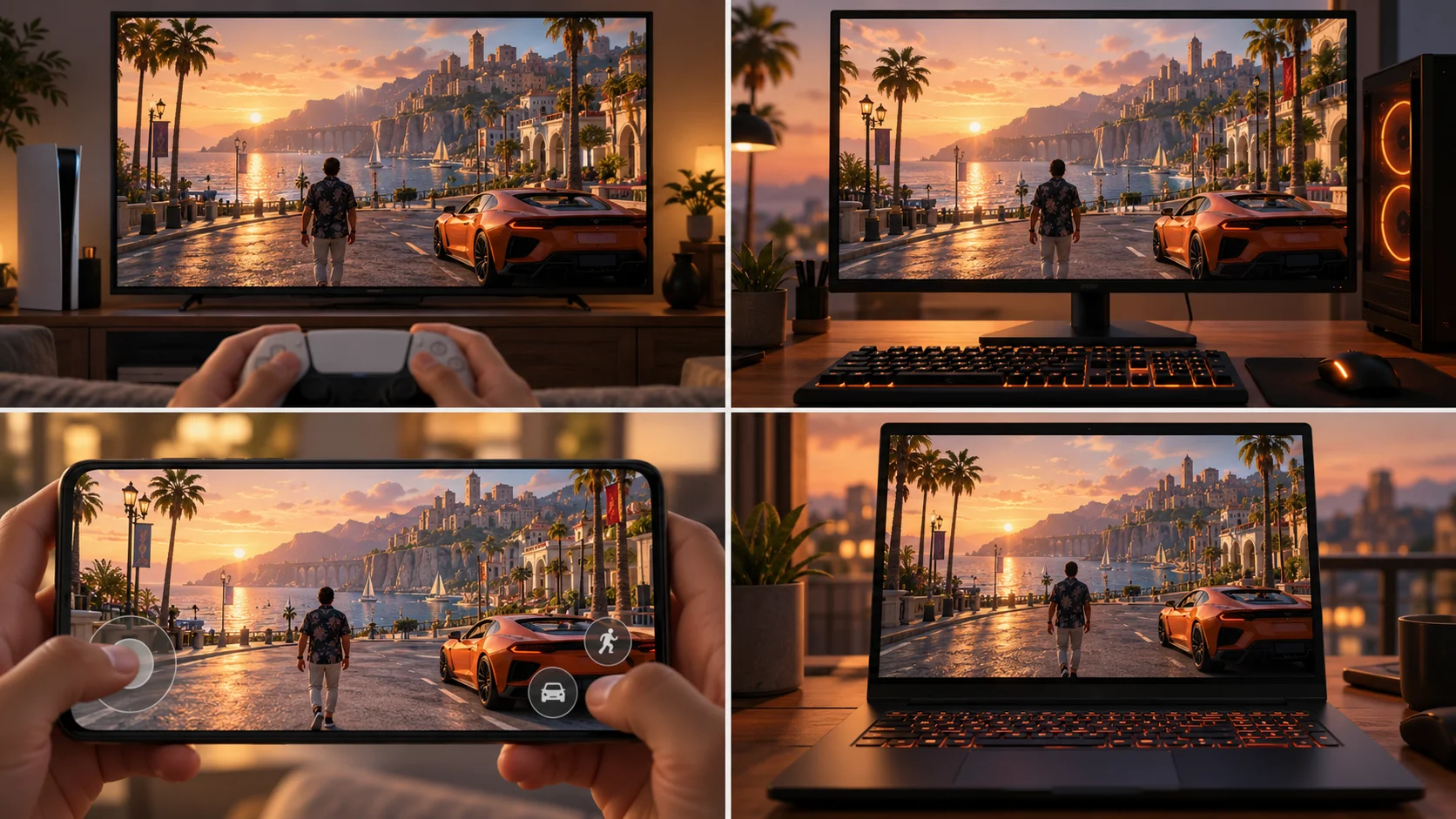
AI-generated screenshot-style concept art. Fictional scene and interfaces, not actual GTA screenshots or a platform graphics comparison. The phone view does not imply GTA VI mobile availability; Steam is a PC storefront.
There is no single compulsory sequence for understanding the franchise. Release order is useful if your goal is to study its design evolution. A particular campaign can also be approached for its own characters and setting. These are different goals, and neither requires pretending that all entries form one uninterrupted biography of the same protagonist.
Release order and story order are different questions. Vice City Stories opens in 1984, while San Andreas places CJ’s return in the early 1990s. GTA IV’s Complete Edition explicitly connects three Liberty City stories. These documented connections are more useful to a newcomer than assuming every appearance of a familiar city name continues the same plot.
Frequently asked questions
Is GTA only about stealing cars?
No. Vehicles are central to movement and many activities, but the series also combines crime stories, on-foot action, exploration and a reactive setting. The balance differs between games, so one entry's feature list should not stand in for the entire franchise.
Is the Definitive Edition a new story?
The Trilogy – The Definitive Edition revisits GTA III, Vice City and San Andreas. It is a collection of updated editions of those games, rather than a new numbered sequel. Guides should specify the edition because technical details and presentation can differ.
Is GTA suitable for young children?
The series contains mature subject matter. Check the rating and content descriptors on the exact game's official listing in your region. An online video of harmless driving does not represent everything contained in a full GTA release.
Are the pictures in this article official screenshots?
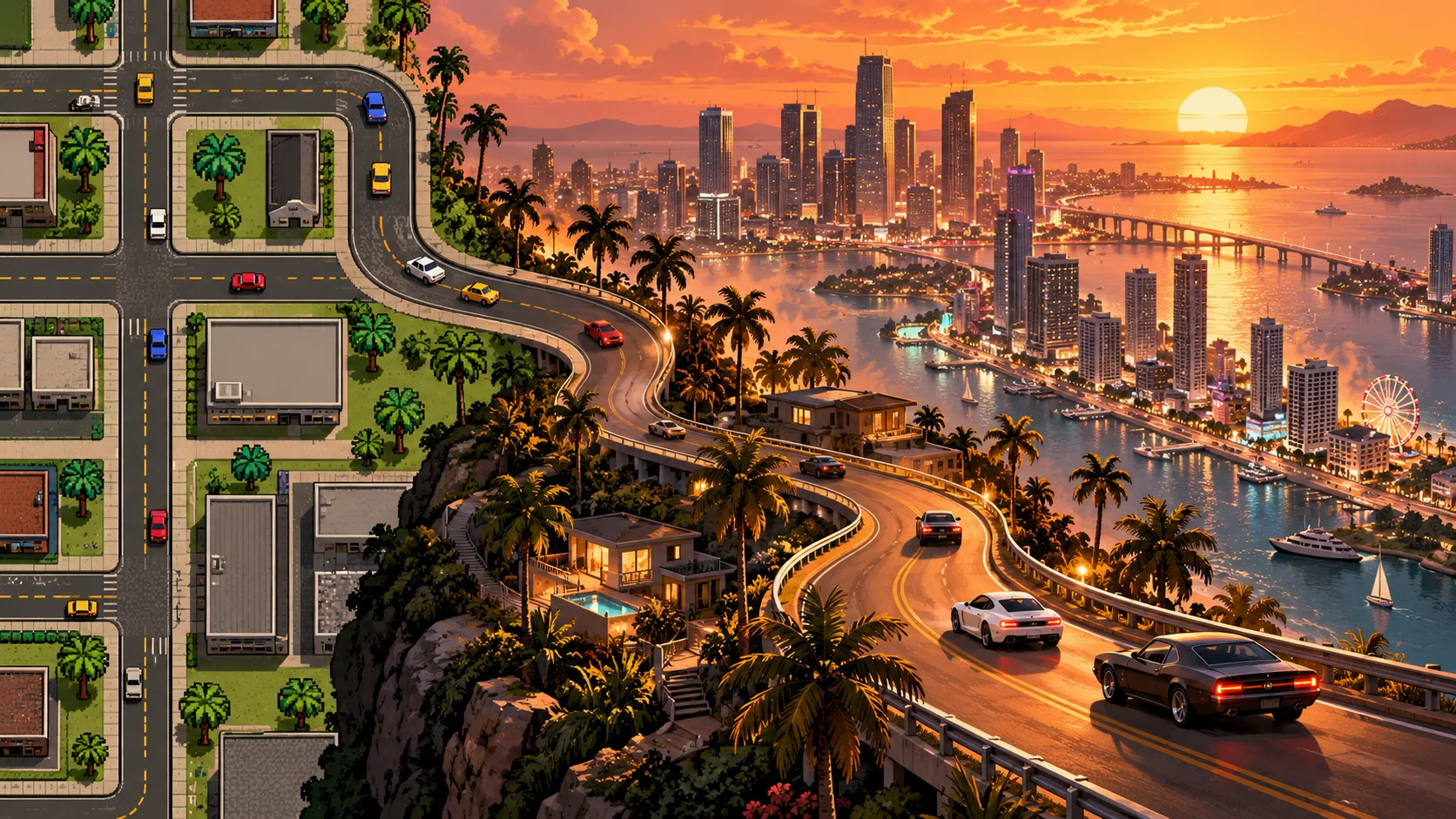
No. The cover is an original AI-generated editorial illustration showing the idea of a city evolving from an overhead layout to a modern open world. It is not a GTA map, Rockstar artwork or evidence of a game feature. Official visual material is available on Rockstar’s GTA VI site.
Read more about how GTA is made
Continue with our Rockstar and GTA developer guide for company and studio credits, or our GTA engines and assets explainer for edition-specific technology.
Research note: This is an AI-assisted, source-based explainer. Historical claims are tied to the named game or edition. Interpretations and general technical explanations are distinguished from publisher-confirmed features; no hands-on testing was performed.
Sources & verification
Sources last verified on . This article covers published information, not hands-on testing.
- Take-Two's historical filing
- Grand Theft Auto: London 1969
- Grand Theft Auto: Vice City
- San Andreas
- Grand Theft Auto Advance
- Liberty City Stories
- Vice City Stories
- Grand Theft Auto IV
- The Lost and Damned and The Ballad of Gay Tony
- Chinatown Wars
- Grand Theft Auto V
- The Trilogy – The Definitive Edition
- tenth-anniversary announcement
- The Trilogy – The Definitive Edition
- Complete Edition listing
- official game manual
- Enhanced PC announcement
- official GTA VI listing