
Rockstar Games is the company most closely associated with Grand Theft Auto, but the name on the box is only the beginning of the story. A large GTA release brings together writing, world design, engineering, animation, performance, music, testing and publishing. Understanding who makes GTA means separating the corporate owner, the publishing label, individual development studios and the people credited on a particular game.
The short answer is that Rockstar Games develops and publishes GTA within the Take-Two Interactive group. Rockstar North is central to the history of the series. The longer answer is more useful: a modern game is a collaboration, and a studio name or a famous creative leader cannot explain every part of the finished work.
This feature covers the public company structure and documented historical roles, then explains how the major disciplines contribute to a game of this type. The production examples are general explanations, not claims of access to Rockstar's offices, schedules or internal documents.
Take-Two, Rockstar Games and Rockstar North: three different levels
Take-Two Interactive is the corporate parent. Its corporate profile identifies Rockstar Games among the labels through which it develops and publishes products. Rockstar Games is the label associated with GTA's development, publishing identity and public announcements. Rockstar North is a development studio within that wider organization.
These names answer different questions. If a reader asks who owns the business behind GTA, the parent-company relationship matters. If the question is who announces and publishes the game, Rockstar Games is the relevant name. If the question concerns the development history of a specific entry, the studio and individual game credits become important.
The series existed before the Rockstar label
Grand Theft Auto began in 1997 at DMA Design, credited in the original game manual preserved by Games Database. Take-Two's 1999 filing supplies contemporary corporate history and dates; the manual is a primary document hosted by an archive. Rockstar Games states in its own anniversary message that the label was founded in 1998. That timing is important: the first GTA did not emerge from an already-established version of the modern Rockstar organization.
DMA Design later became associated with the Rockstar North identity. The history is therefore an evolution of teams and businesses, not a single company appearing fully formed with GTA V. Take-Two's historical filings identify Rockstar North as the developer of the GTA series; its 2005 annual filing is one contemporary example of that relationship.
For historical reporting, the studio name used at the time matters. Calling an early DMA release a Rockstar North game may help a modern reader recognize the lineage, but it should not erase the original credit. The same care applies to remasters: the studio that originally created a game and the studio adapting it years later may differ.
What Rockstar North contributes to the history
A contemporary source is more useful than a broad claim that one studio made everything. Rockstar's April 2008 GTA IV launch announcement names Rockstar North as developer and identifies Leslie Benzies as series producer and Rockstar North president at that time. It also names Sam Houser as Rockstar's founder. These are historical roles, not a current staff directory.
The same announcement describes Liberty City as the setting and identifies Xbox 360 and PlayStation 3 as the launch platforms. That context matters: a later PC edition or remastered release can add contributors and technology without changing who led the original release.
Rockstar North's importance does not make other credits incidental. GTA is a combination of writing, mission design, environment and character art, engineering, performance, sound and testing. A studio credit tells us who developed a release; it does not identify the individual who built every vehicle or wrote every scene.
The wider Rockstar organization
Take-Two's company directory lists Rockstar entities across several regions, including the United States, the United Kingdom, Canada and India. This supports describing Rockstar as a wider organization, rather than imagining GTA as the output of a single small room.
Developers and creative leaders associated with GTA
Sam Houser, Dan Houser and Leslie Benzies received the Academy of Interactive Arts & Sciences' 2014 Hall of Fame recognition. The Academy's announcement documents that recognition; it is not a list of GTA VI's current team.
The GTA IV roles described above illustrate the difference between creative leadership and an individual production task. A founder, producer, artist and programmer can influence the same release in different ways. No one credit establishes who personally authored every mission, model or line of code.
The names of earlier creative leaders should not be copied into a new game's credits automatically. This guide does not assign GTA VI writing, art direction or production roles to individuals based solely on their association with GTA IV or GTA V. Its own released credits and direct project statements are the appropriate evidence.
Writers, narrative designers and mission designers
GTA IV and GTA V illustrate two different narrative structures. Rockstar's GTA IV Complete Edition listing brings together Niko Bellic's campaign with Johnny Klebitz's The Lost and Damned and Luis Lopez's The Ballad of Gay Tony. The stories intersect in Liberty City, giving the same setting more than one perspective.
Rockstar's GTA V launch announcement identifies Rockstar North as developer and describes Michael, Franklin and Trevor's shared campaign structure, including the ability to change protagonists. From a design perspective, that creates a different problem: the player must understand whose actions they control and how each objective relates to the other protagonists. This is an interpretation of the documented structure, not a claim about the team's private design meetings.
Writing establishes motives and relationships; mission design connects them to playable objectives, routes, success conditions and failure recovery. In GTA, travel is often part of that connection. A conversation during a drive must coexist with navigation and player input. This explains why the quality of a crime story cannot be assessed solely by reading its dialogue out of context.
The distinction also helps readers evaluate credits. A writer, a mission designer and a performer can contribute to the same scene in different ways. Naming only one famous person obscures that collaboration.
World artists, character artists and technical artists
World artists create the visible environment: buildings, roads, terrain, vegetation, props and the surfaces that give them character. Character artists work on people, clothing and related visual detail. Art direction helps these different contributions belong to a coherent world instead of appearing to come from unrelated projects.
A believable street needs more than a high-detail building. The scale of doors, the width of sidewalks, the wear on surfaces and the relationship between signs and storefronts all influence whether the location feels intentional. Repetition can help establish an architectural style, while selective differences make places recognizable.
Technical art connects visual goals to runtime constraints. A beautiful asset may still be too expensive to draw repeatedly or may deform poorly when animated. Technical solutions can involve export rules, shaders, rigging, validation and ways of reducing complexity at a distance. The exact toolchain varies; the underlying problem is balancing appearance, reliability and performance.
Programmers and the systems behind the experience

Original AI-generated illustration for NextPlayIntel. Generic educational assets, not extracted GTA models or official artwork.
Programming in a large game includes many specialisms. Rendering work concerns how a scene becomes an image. Gameplay programming concerns rules and interaction. Tools programming helps other developers build and inspect content. Systems work deals with the foundations that keep data, memory and execution organized.
These areas meet constantly. A car is an art asset, but it also needs movement, collision, audio, animation and behavior. A mission is authored content, but it depends on systems that recognize its conditions and preserve progress. When a problem appears on screen, its cause may sit in any of these connections rather than in the most visible component.
Actors, animators, audio teams and music
GTA's music is not all one kind of asset. Licensed radio tracks and music composed for the game have different origins and credits. For GTA V, Film at Lincoln Center's joint event announcement with Rockstar names Tangerine Dream, Woody Jackson, The Alchemist and Oh No as composers of the original score. The 2013 event included a discussion of scoring an interactive game and a live performance.
An original score can support changing dramatic situations, while a radio song is also part of the fictional station and its identity. These are different creative functions even when the player hears both during the same session. Crediting Rockstar as publisher does not erase the composers, performers or recording rights involved.
Dialogue performance, animation and audio implementation also meet in the finished scene. A spoken line needs timing and delivery; a character needs motion that fits the interaction; the mix must leave important speech understandable alongside vehicles and environmental sound. Those are general production relationships, not an assertion about an undisclosed Rockstar recording setup.
Our illustrations show fictional workers and educational asset concepts. They are not photographs of the named composers, Rockstar employees or a real studio.
Quality assurance, localization and release work
Quality assurance investigates whether the game behaves as intended. In an open world, that means examining combinations as well as individual features. A mission might work on its expected route but fail when a vehicle is damaged, an objective is reached in an unusual order or a save is loaded at a sensitive moment.
Localization also extends beyond replacing words. Text must fit interfaces, instructions must remain understandable, subtitles need appropriate timing and names must be handled consistently. A sentence that is clear in one language may become too long for a menu or ambiguous in another.
Release work brings together builds, platform requirements, distribution and support. A successful local test is not the same thing as a release that installs correctly and behaves consistently across supported configurations. These roles often attract less attention than trailers or protagonists, but they are essential to turning a creative project into a usable product.
Remasters and ports have their own developers
There are concrete GTA examples of different credit arrangements:
Liberty City Stories credits Rockstar Leeds and Rockstar North. Take-Two's PS2 launch announcement explicitly describes their collaboration.
Grand Theft Auto Advance credits Digital Eclipse for the Game Boy Advance title.
The Trilogy – The Definitive Edition was adapted to modern platforms by Grove Street Games using Unreal Engine, according to Rockstar's November 2021 announcement.
These examples answer different questions. The original studio credit concerns creation of an earlier game; an adaptation credit concerns a later edition. Neither should be silently substituted for the other. A review of the Definitive Edition is evaluating a particular version, not automatically every release of III, Vice City or San Andreas.
A port may retain the story while changing controls, rendering and platform integration. For a documented mobile example, Take-Two's Liberty City Stories iOS announcement describes improvements for that adaptation. A phone version should be discussed on its own terms rather than assumed to match a console edition feature for feature.
How to evaluate claims about the people making GTA
Start with the claim's scope. A historical credit, a present job title, a corporate ownership statement and a rumor about a new game are four different kinds of information. They need different evidence. A corporate directory can support an organizational relationship, but not a claim about who wrote a particular scene.
For individual contributions, consult the credits for the exact game and edition. For corporate structure, use company filings and official profiles. For new features, use a dated official announcement or clearly attribute reporting. Avoid turning a social-media interpretation into a statement that a developer has confirmed something.
Frequently asked questions
Is Rockstar the same company as Take-Two?
They are related but describe different organizational levels. Take-Two is the corporate parent; Rockstar Games is a label within the group. Treating the names as interchangeable can obscure whether a statement is about the parent business or a particular game operation.
Does one developer create the entire game?
No. The credits show many disciplines and contributors. Prominent creative leaders can have substantial influence, but their roles do not replace the work of artists, engineers, performers, designers, testers and support teams.
Are the developers shown in the illustration real people?
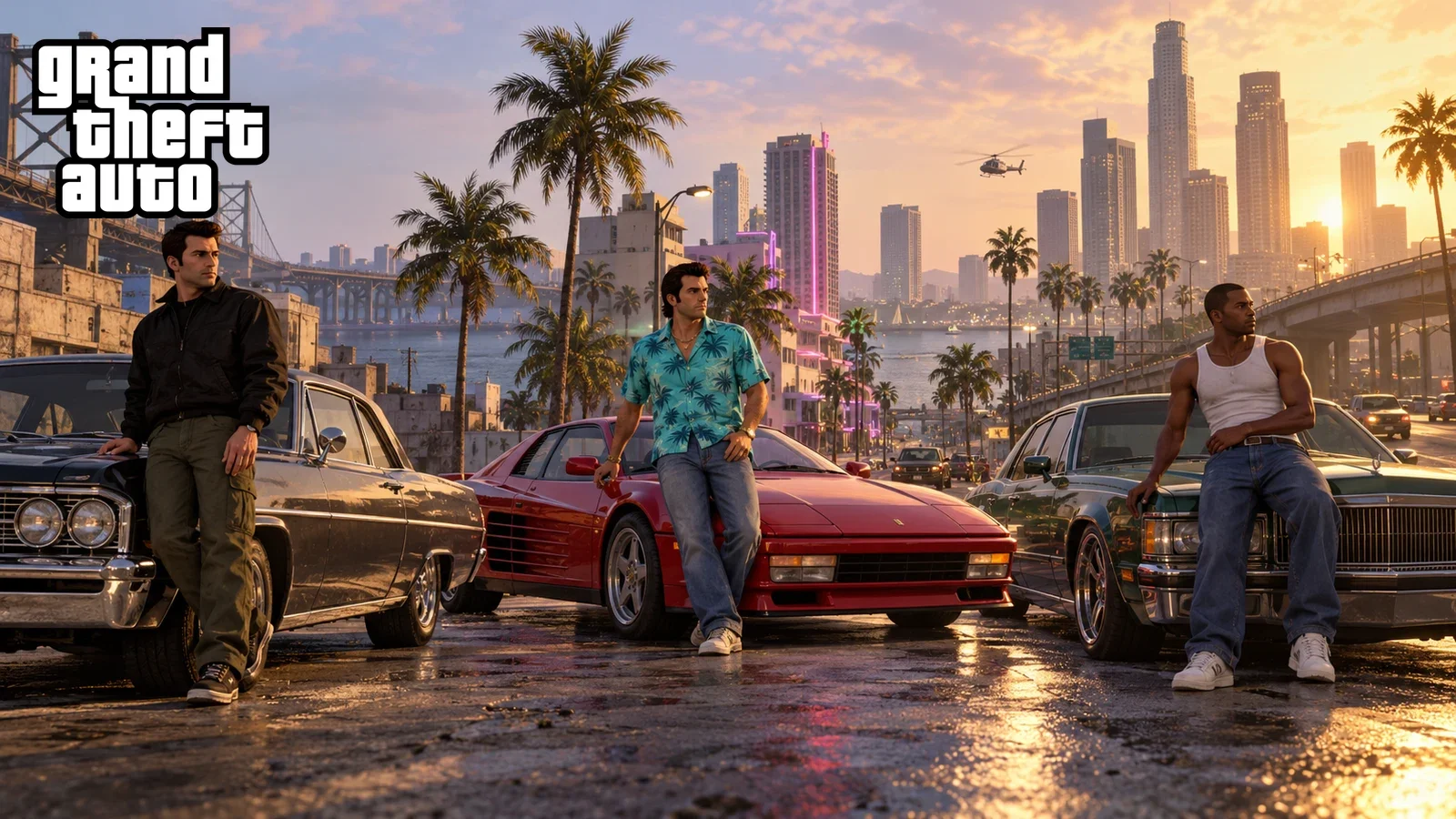
No. The AI-generated cover is a conceptual illustration of collaborative game development. It does not depict actual Rockstar employees, facilities or internal tools, and it should not be used as documentary evidence about how a specific studio looks.
Why does this article avoid assigning GTA VI tasks to individual studios?
Because an office's existence or a past credit does not establish its exact responsibility on another project. The article distinguishes documented history from general production explanations and leaves unsupported task assignments out.
Continue reading
Our GTA games and history guide explains the individual campaigns. The GTA technology guide separates documented engine features from general graphics concepts.
Research note: This is an AI-assisted, source-based explainer. Historical claims are tied to the named game or edition. Interpretations and general technical explanations are distinguished from publisher-confirmed features; no hands-on testing was performed.
Sources & verification
Sources last verified on . This article covers published information, not hands-on testing.
- corporate profile
- original game manual
- Take-Two's 1999 filing
- anniversary message
- 2005 annual filing
- Rockstar's April 2008 GTA IV launch announcement
- company directory
- Academy's announcement
- GTA IV Complete Edition listing
- Rockstar's GTA V launch announcement
- Film at Lincoln Center's joint event announcement with Rockstar
- Liberty City Stories
- PS2 launch announcement
- Grand Theft Auto Advance
- The Trilogy – The Definitive Edition
- Liberty City Stories iOS announcement