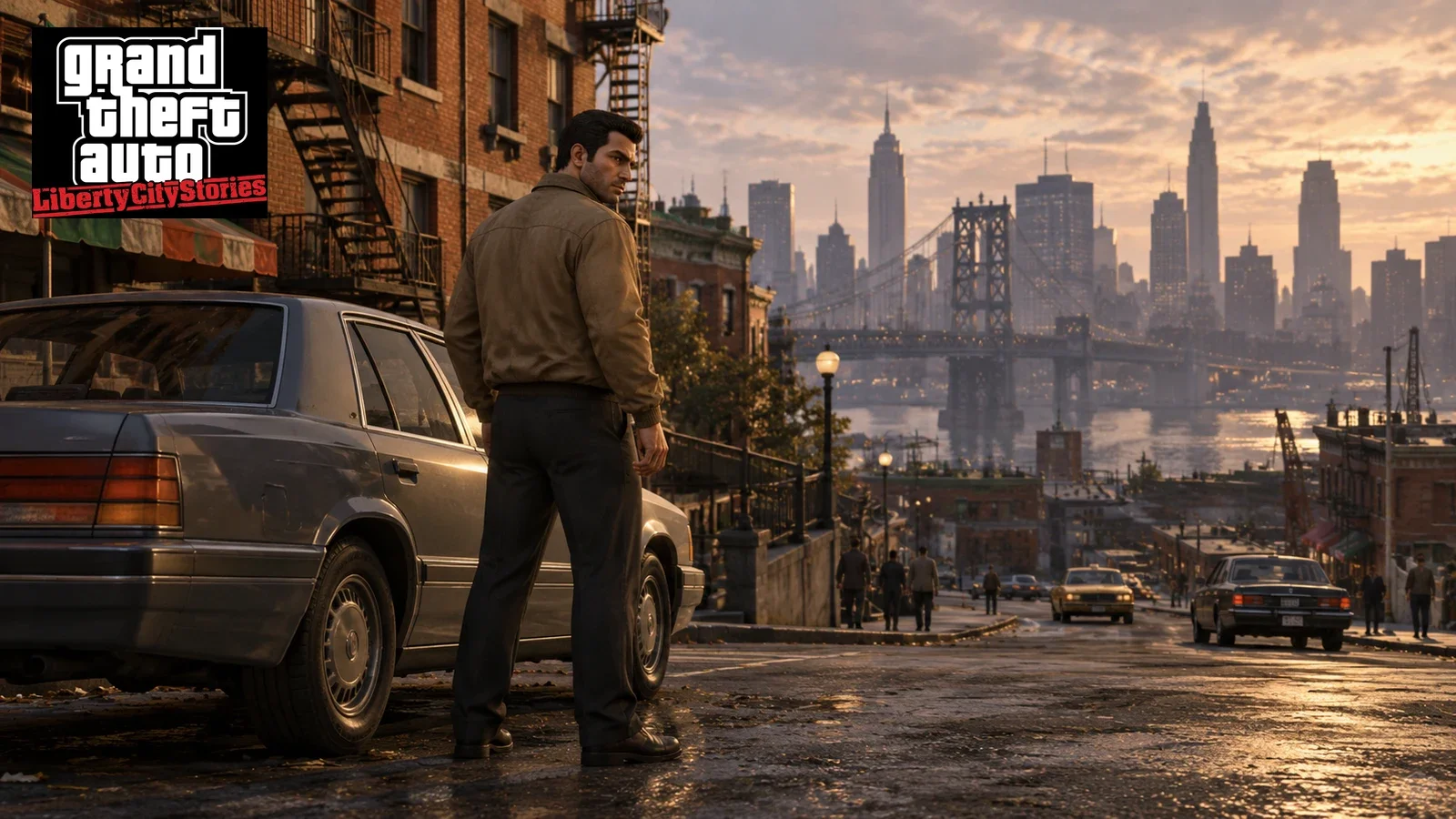
Grand Theft Auto: Liberty City Stories makes Toni Cipriani the protagonist of a story set before GTA III. It revisits the same broad city identity while showing a different moment in its criminal politics and construction. Its original PSP release also demonstrates a different approach to portable GTA from the overhead Game Boy Advance game.
The game first arrived in 2005. Its fictional setting is 1998, three years before GTA III. Release order and story chronology therefore point in different directions: the prequel was made after the game whose background it expands.
Rockstar Leeds, Rockstar North and individual credits
Rockstar Leeds developed Liberty City Stories in conjunction with Rockstar North. Rockstar's PS2 release announcement identifies that collaboration. The portable production should not disappear behind a generic 'Rockstar North made every GTA' credit.
The credits transcription names Leslie Benzies as producer and Aaron Garbut as art director on the North side. At Leeds, Gordon Hall is credited as studio director and David Box as head of development. Dan Houser, James Worrall and David Bland receive writing credits; Andrew Greensmith and Matthew Shepcar appear in lead programming roles.
These historical roles explain how an established GTA world could be adapted through collaboration. They are not a complete list of everyone involved, nor a statement about the individuals' current positions. The PSP, PS2 and mobile credits also should not be assumed identical.
Toni's return to the Leone family
Toni returns to Liberty City and resumes work connected to Salvatore Leone's organization. His standing is not automatically secure. The story places him among people who want his loyalty and labor while competing over status, territory and influence.
Vincenzo Cilli initially holds authority over Toni. Joseph Daniel O'Toole supplies another route into the city's criminal relationships, while Ma Cipriani adds a particularly personal source of pressure. Salvatore, Maria and Donald Love connect the prequel to figures familiar from GTA III. The character reference documents those roles.
Toni is not Claude with a different model. His dialogue and family obligations give the campaign a different tone. Playing GTA III first can make returning faces more recognizable, but Liberty City Stories explains its immediate conflicts through its own missions.
Liberty City in 1998
The setting uses Portland, Staunton Island and Shoreside Vale, with differences that reflect the earlier period. Construction and changes to particular locations make the return meaningful rather than a simple repetition of the 2001 map.
For navigation, familiar geography gives a useful starting point but should not replace observation. A route available in one game may be altered in the other. The presence of motorcycles also changes how quickly Toni can move through traffic compared with Claude's original game.
The city should also be distinguished from GTA IV's later reimagining of Liberty City. A matching place name does not make the maps interchangeable. This is the GTA III-era version, with its own continuity and street layout.

Missions designed around a portable game
Liberty City Stories retains the third-person mix of driving, combat and jobs from criminal contacts. The portable context affects controls and how information is presented, but the ambition is a substantial open-city campaign rather than a small set of isolated arcade stages.
When learning the controls, focus on camera management as well as movement. A situation that feels difficult may be caused by an awkward view rather than inadequate firepower. Repositioning before engaging can be more effective than repeatedly attacking from the same spot.
Side activities and exploration create reasons to revisit neighborhoods beyond the story. Separate those optional goals from the immediate campaign chain. If a mission is troublesome, preparing health, armor and a suitable vehicle can reduce avoidable failure without requiring a cheat.
PSP, PS2 and mobile are distinct versions
The PSP original was followed by a PS2 release in 2006 and later mobile adaptations. The PSP included local wireless multiplayer; that should not be described as the same service as GTA Online or assumed present in every port.
Rockstar's 2015 mobile announcement describes updates including touch controls and presentation changes for iOS. Those are historical launch claims, not a guarantee that every old cloud service or device remains supported today. Current storefront compatibility must be checked for the particular phone and operating system.
PSP shoulder buttons are labelled L and R; a PS2 guide typically refers to L1 and R1. That small difference becomes important when entering codes. A copied list that leaves the platform unstated can make a valid sequence look wrong or encourage the player to press the wrong shoulder control.
What this game adds to the catalogue
Liberty City Stories shows that revisiting a city can provide a new viewpoint without requiring a completely new map identity. The protagonist, chronology and relationships change how familiar locations are understood. Its production also gives Rockstar Leeds a prominent role in the series' history.
Use the LCS cheat guide for PSP and PS2 sequences and mobile limitations. Continue with Vice City Stories to see the portable branch move to a different period and a business-focused progression system.
Sources & verification
Sources last verified on . This article covers published information, not hands-on testing.
Editorial & update notes
AI-assisted research and writing based on the linked references. This is not a hands-on review. Images are labelled AI-generated illustrations, not gameplay screenshots.