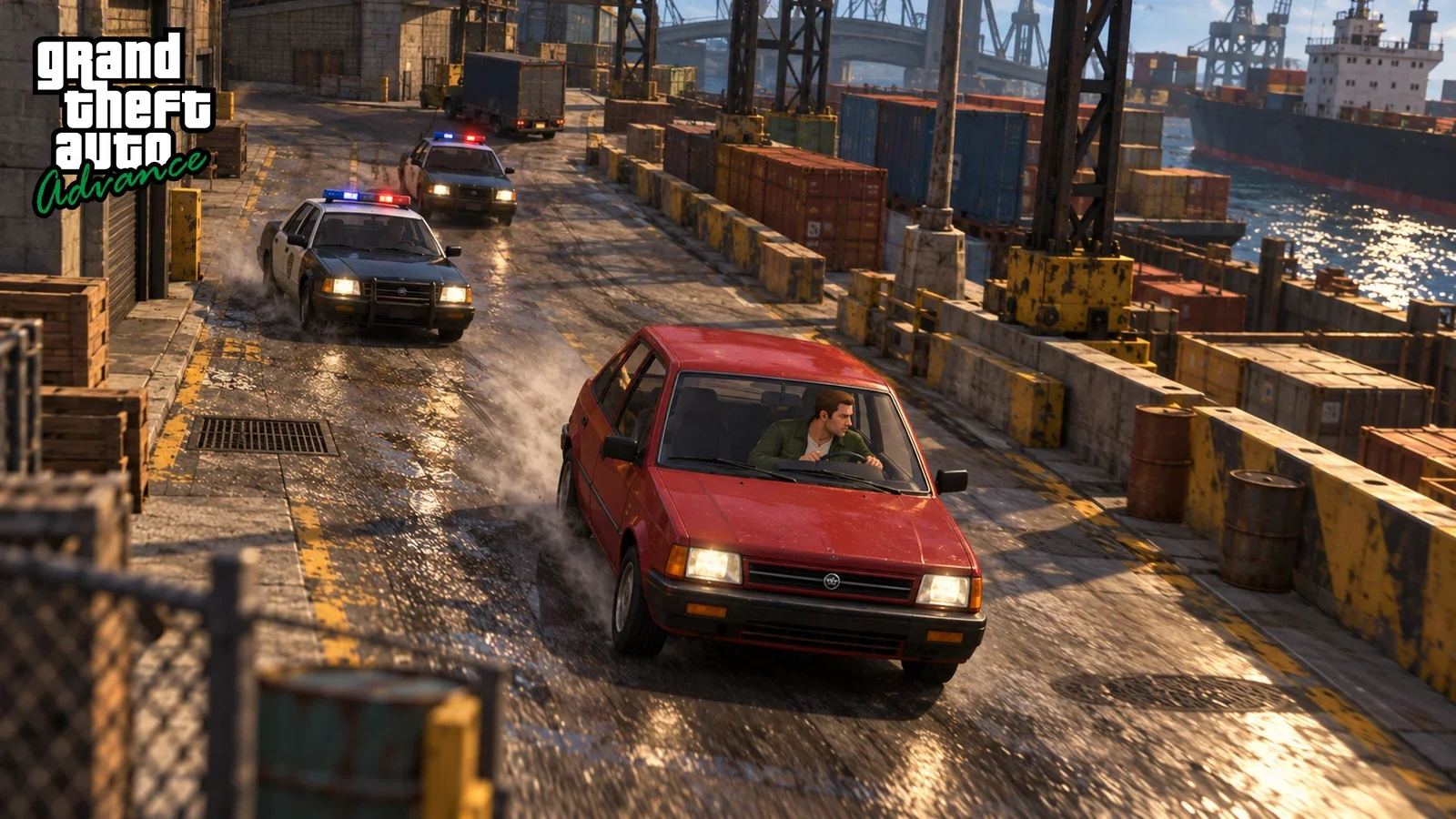
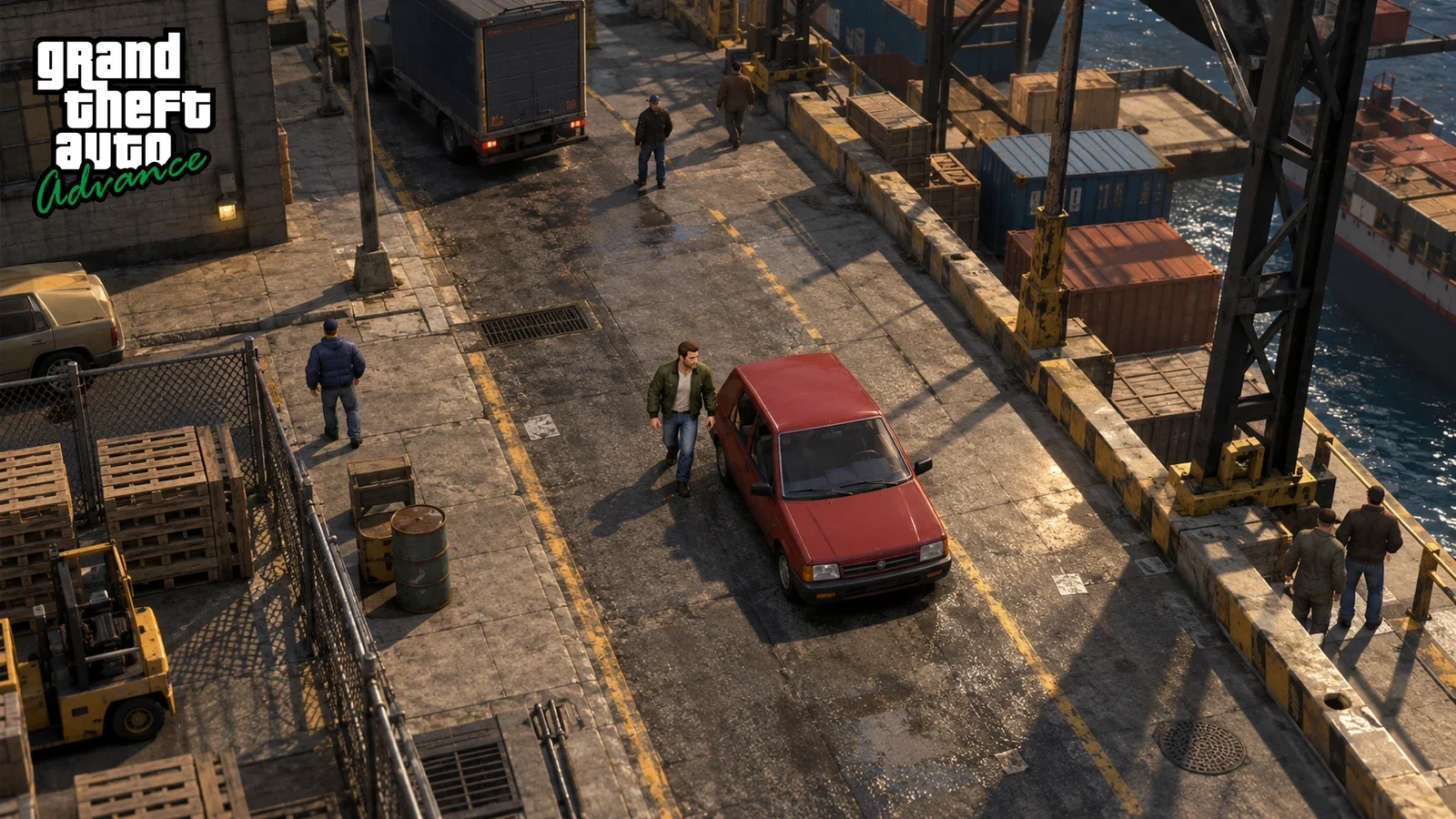
Grand Theft Auto Advance is a separate story made for the Game Boy Advance. It is not GTA III squeezed unchanged onto a cartridge, even though it revisits Liberty City and several familiar characters. The overhead perspective recalls the earliest GTA games while the setting connects it to the era of Claude's adventure.
Released in 2004, it shares a release period with San Andreas but pursues a very different hardware problem. Understanding those constraints helps explain its presentation without reducing the game to a comparison it was never designed to win.
Digital Eclipse and the development credits
Digital Eclipse developed GTA Advance, with Rockstar Games publishing it. Rockstar's official game page identifies the studio and platform. It is therefore inaccurate to credit this release solely to Rockstar North because that studio made the major home-console GTA games of the period.
The Game Boy Advance credits list William Baffy, Andrew Ayre and Jeff Vavasour among the senior producers, with Robert Baffy as audio director. These are selected credits, not an exhaustive staff list. They distinguish the production team from Mike, Vinnie and the other fictional people in the campaign.
Adapting an open city to a handheld involves more than shrinking an image. Input has fewer buttons, the display gives less space to text and scenery, and every mission needs to remain understandable within that presentation. The relevant question is how those limitations are accommodated, not whether the result resembles a PS2 screenshot.
Mike, Vinnie and the opening mystery
Mike wants to leave Liberty City with his associate Vinnie. When a car bombing appears to kill Vinnie and destroys their escape plan, Mike becomes involved in an investigation through the city's criminal contacts. That opening provides the motive for a sequence of jobs and shifting alliances.
Important characters include Vinnie, 8-Ball, King Courtney, Asuka Kasen and Cisco. Their presence connects the story to familiar organizations and services without making Mike a replacement name for Claude. The game and story reference documents the premise and cast; its full synopsis contains major spoilers that this introduction avoids.
The story is set before GTA III. Knowing that relationship is useful, but playing Advance is not required to understand Claude's opening. A prequel can add context without functioning as mandatory homework for another game.
A different view of Liberty City
Portland, Staunton Island and Shoreside Vale return in an overhead interpretation. The city is adapted to the game rather than reproduced as a mechanically identical map. Roads and landmarks may be recognizable while elevation, tunnels or routes differ from the PS2 version.
For a player arriving from GTA III, familiar names can be both helpful and misleading. They tell you roughly what kind of place you are visiting, but they do not guarantee that the same shortcut or road connection exists. Learn the actual handheld layout instead of navigating entirely from memory of another game.
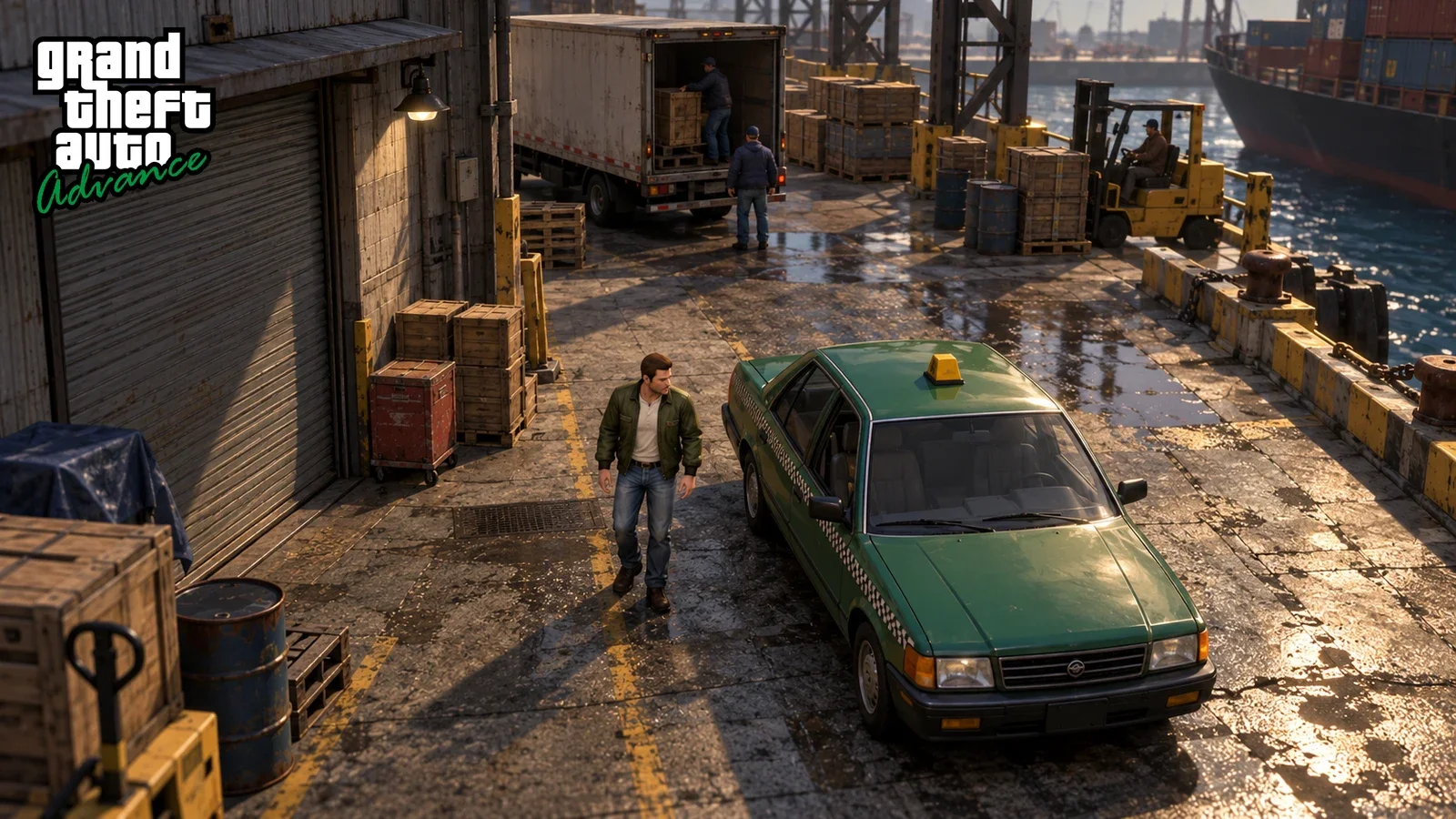
The camera emphasizes vehicle position and the immediate road network. A small sprite has to communicate direction and movement clearly, while buildings and intersections must remain readable on a compact screen. Those visible priorities explain why the asset style differs so sharply from the home-console games.
Missions and handheld pacing
The campaign combines driving and combat with the recurring GTA task of traveling between contacts. Text and portraits carry much of the storytelling rather than long, fully voiced cinematic scenes. This makes reading the objective carefully especially important.
Approach unfamiliar missions as a sequence of questions: where is the destination, what must arrive there, and what causes failure? A task that requires preserving a vehicle demands a different route from one that simply requires Mike to reach a marker. The overhead camera can make both look similar at first glance.
Vehicle-based side activities provide other reasons to move through the map. They are useful for learning streets, but optional activity progress should be distinguished from main-story progress. A long session of driving around is not necessarily evidence that the next story contact has been completed.
Presentation and technical expectations
Advance does not reproduce the full cinematic and radio presentation of GTA III. Its dialogue delivery, sound and visual scale reflect the target platform. That does not make every difference an error; some are foundational choices required by the format.
At the same time, hardware context should not be used to invent technical achievements. This article does not claim a particular engine architecture, frame rate or memory budget without a production source. The observable distinction is enough: it is an overhead handheld game with a separate story and adapted city.
For readers researching game assets, compare how a character is communicated through a portrait and sprite here with how a 3D model, animation and voice performance work together in GTA III. Both approaches convey identity, but they distribute the work differently across art and writing.
Platform availability and cheats
The official release covered here is Game Boy Advance. There is no separate native PlayStation, Xbox, PC, iOS or Android edition in this catalogue. Emulation on another device still runs the GBA game and uses its button inputs; it does not create a new mobile cheat list.
Our GTA Advance cheat guide explains the activation step and documented GBA sequences. It also separates built-in inputs from external cheat-device codes, which should never be mixed into a simple button guide without explanation.
For the next major portable GTA approach, read Liberty City Stories on PSP. For the story that follows Mike's era of the city, see GTA III.
Sources & verification
Sources last verified on . This article covers published information, not hands-on testing.
Editorial & update notes
AI-assisted research and writing based on the linked references. This is not a hands-on review. Images are labelled AI-generated illustrations, not gameplay screenshots.