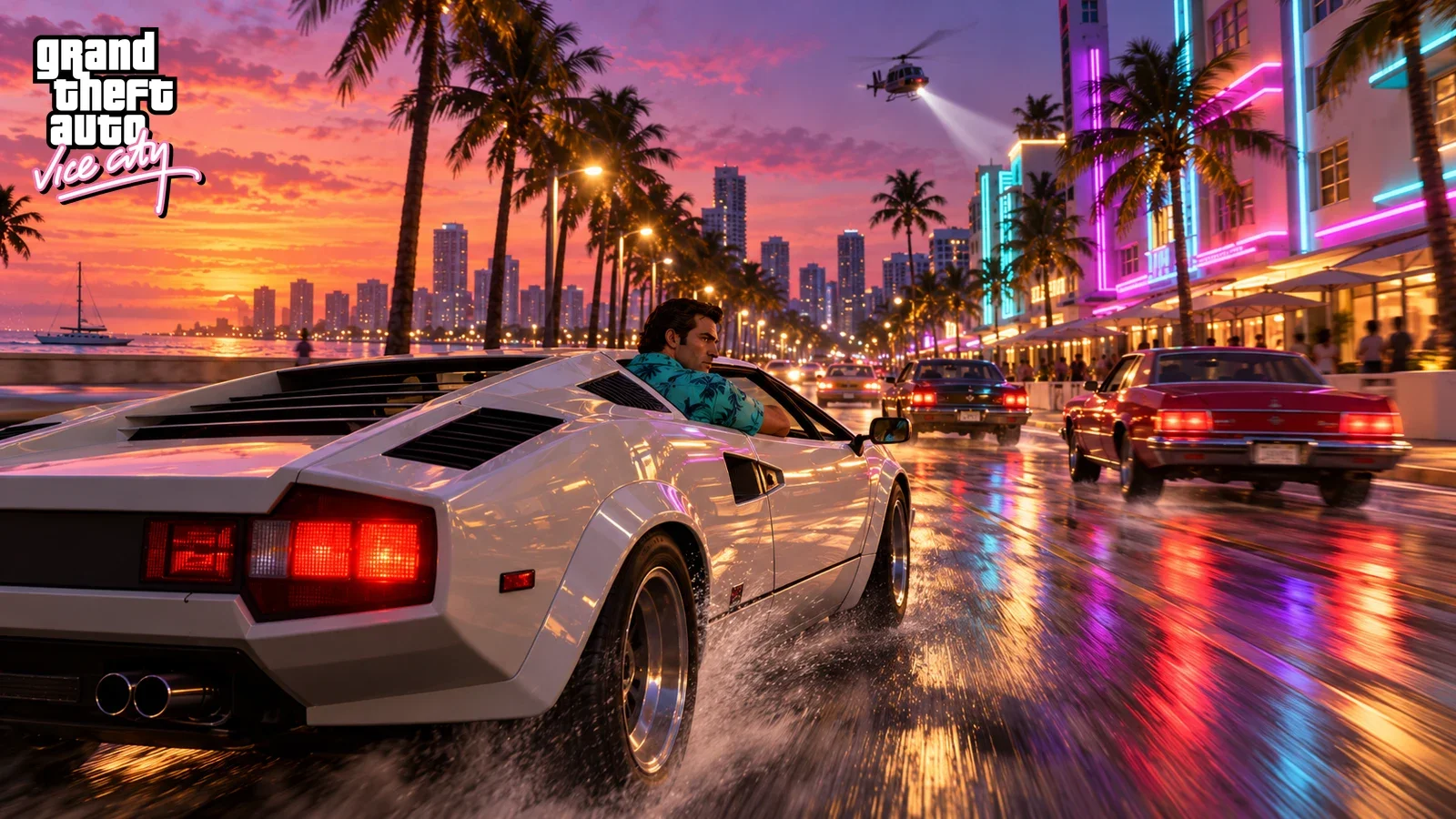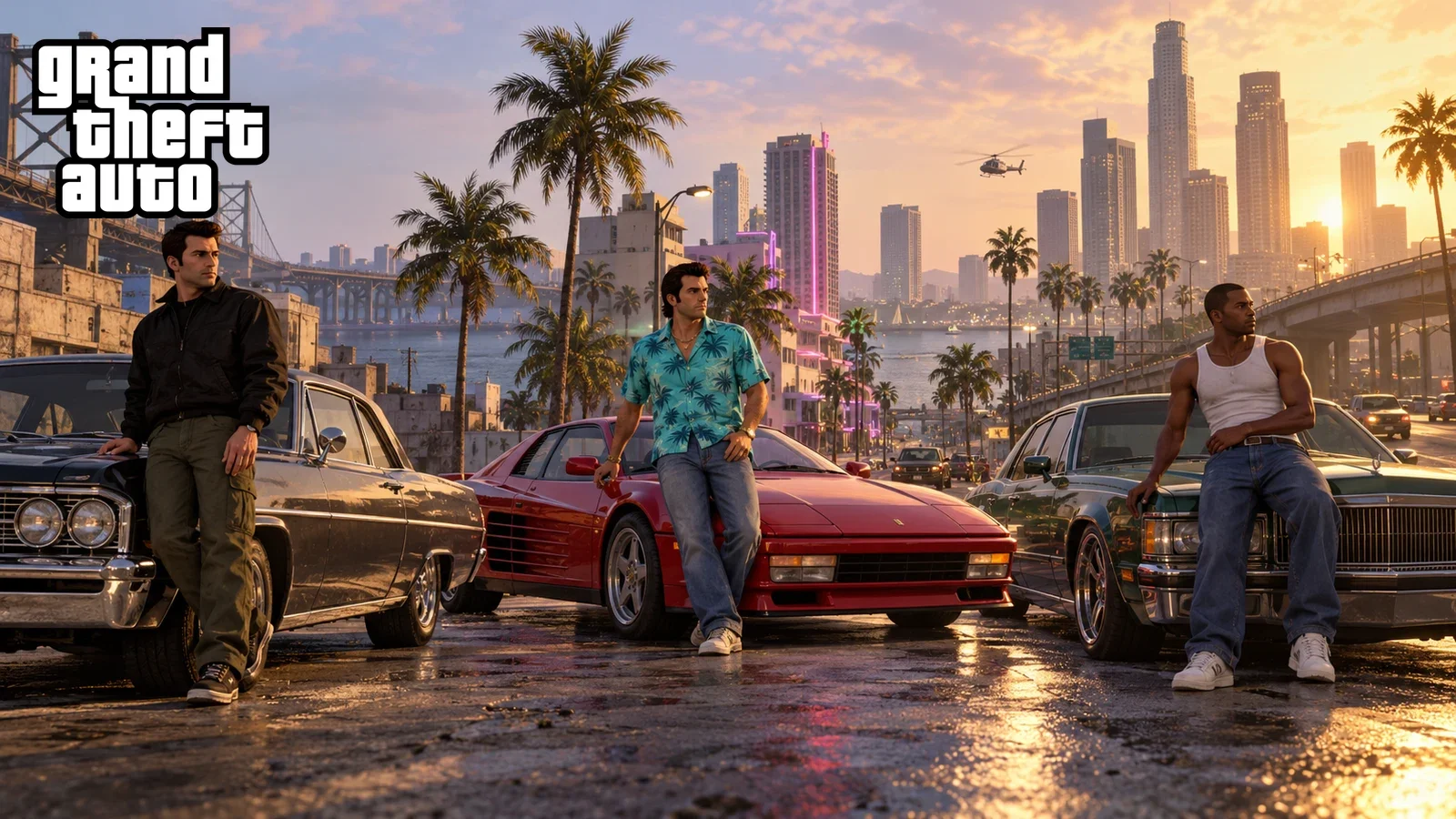
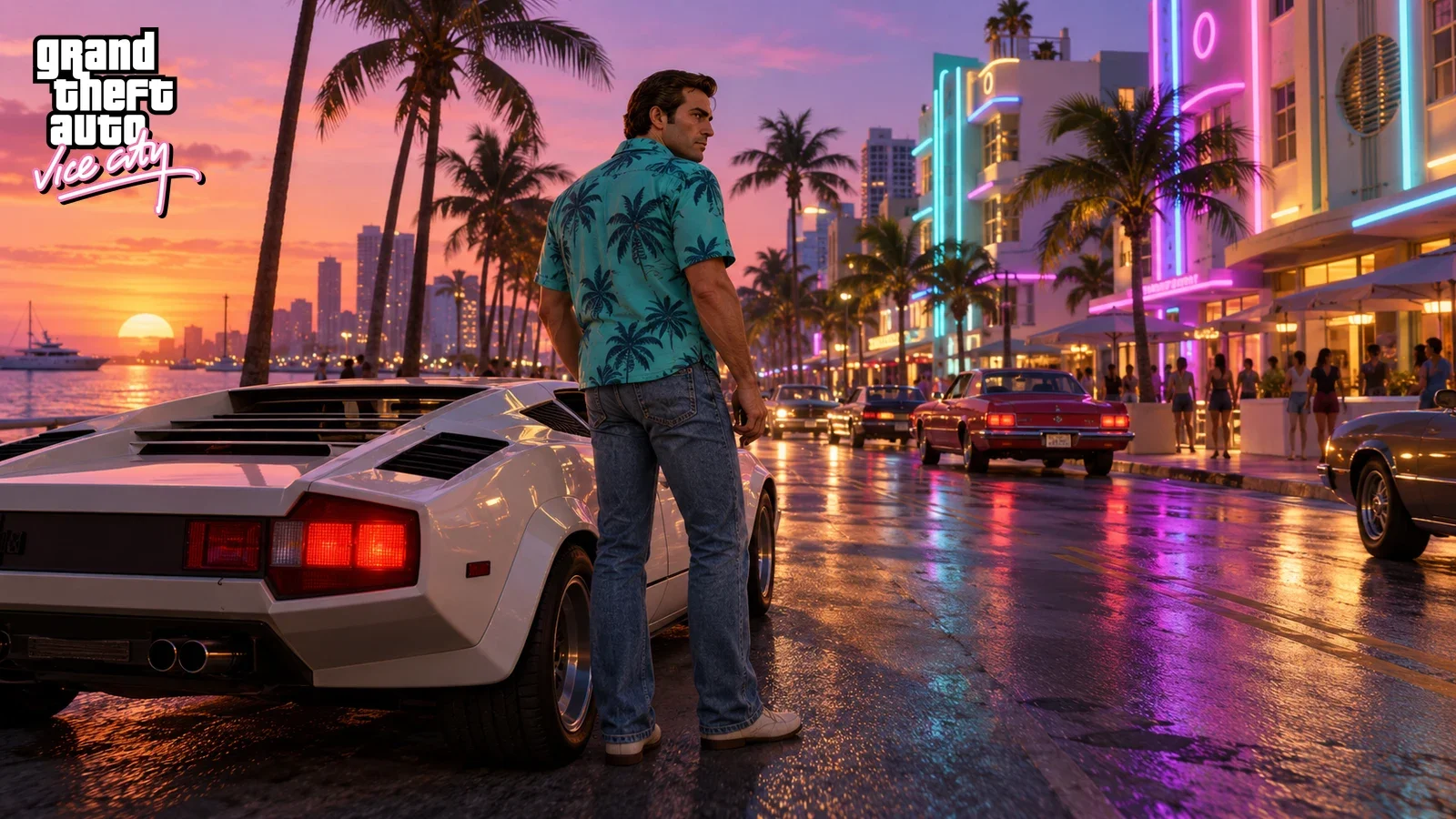
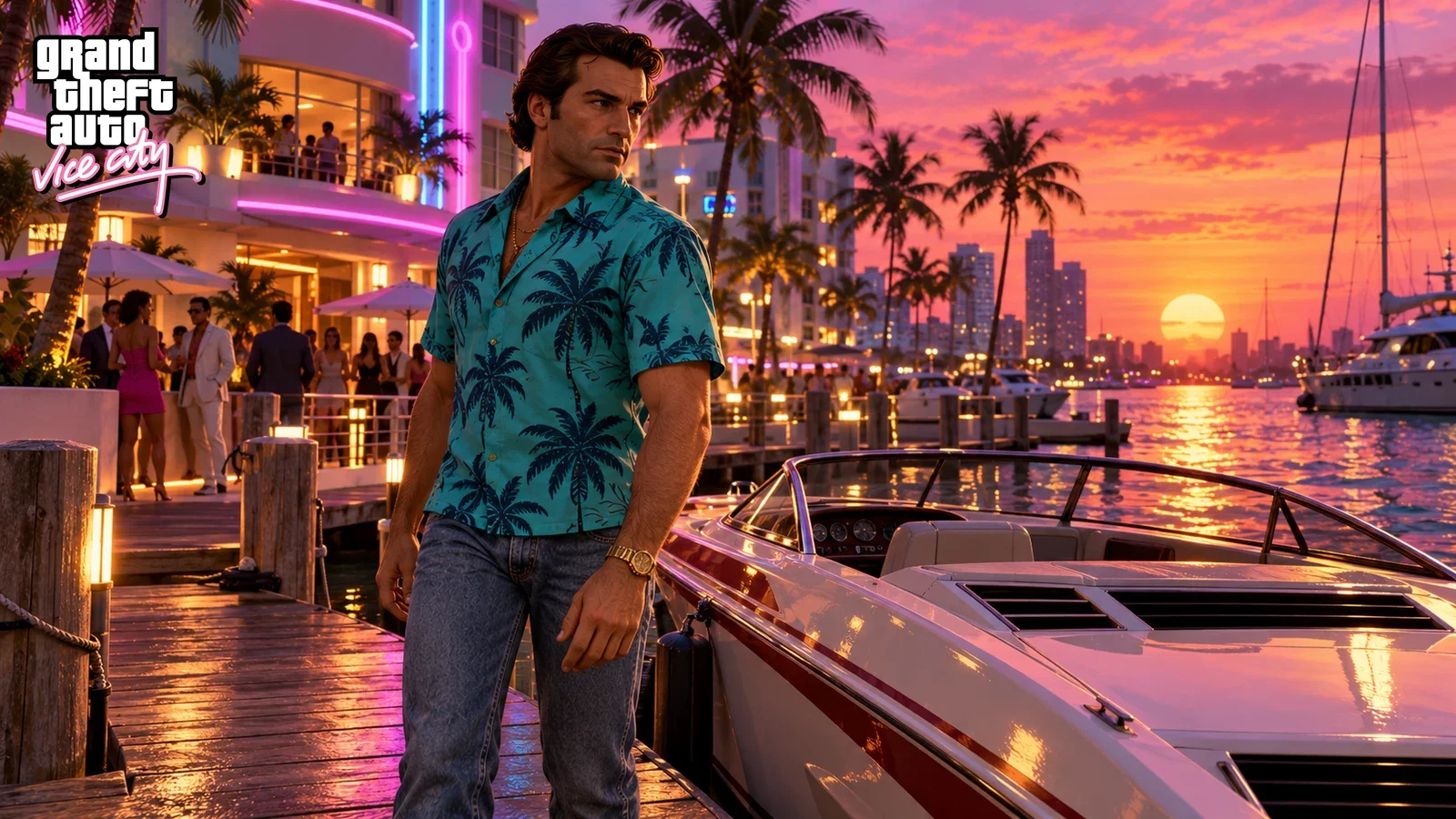
Grand Theft Auto: Vice City gives the third-person GTA formula a more explicit protagonist and a strong period identity. Tommy Vercetti talks back, makes demands and gradually turns a failed assignment into a struggle for ownership. The city is not only a place to cross for someone else's jobs; businesses become part of his rise.
The game was released in 2002 and is set in 1986. Its tropical streets, radio music, clothes and criminal ambitions work together to establish that period. This guide introduces the story and characters without revealing the final confrontation.
Who developed GTA Vice City?
Rockstar North developed Vice City, with Rockstar Games publishing it. This is the studio that had previously been called DMA Design. Leslie Benzies is associated with production, Aaron Garbut with art direction, and Dan Houser and James Worrall with the writing. Edition-specific credits can be consulted in the official PC manual.
The named creative roles should not be confused with the voice cast. Ray Liotta performs Tommy Vercetti; the actor gives the protagonist a recognizable delivery, while writing, animation, mission design and programming determine what the character says and does in the game. A character's voice actor is not automatically the game's developer.
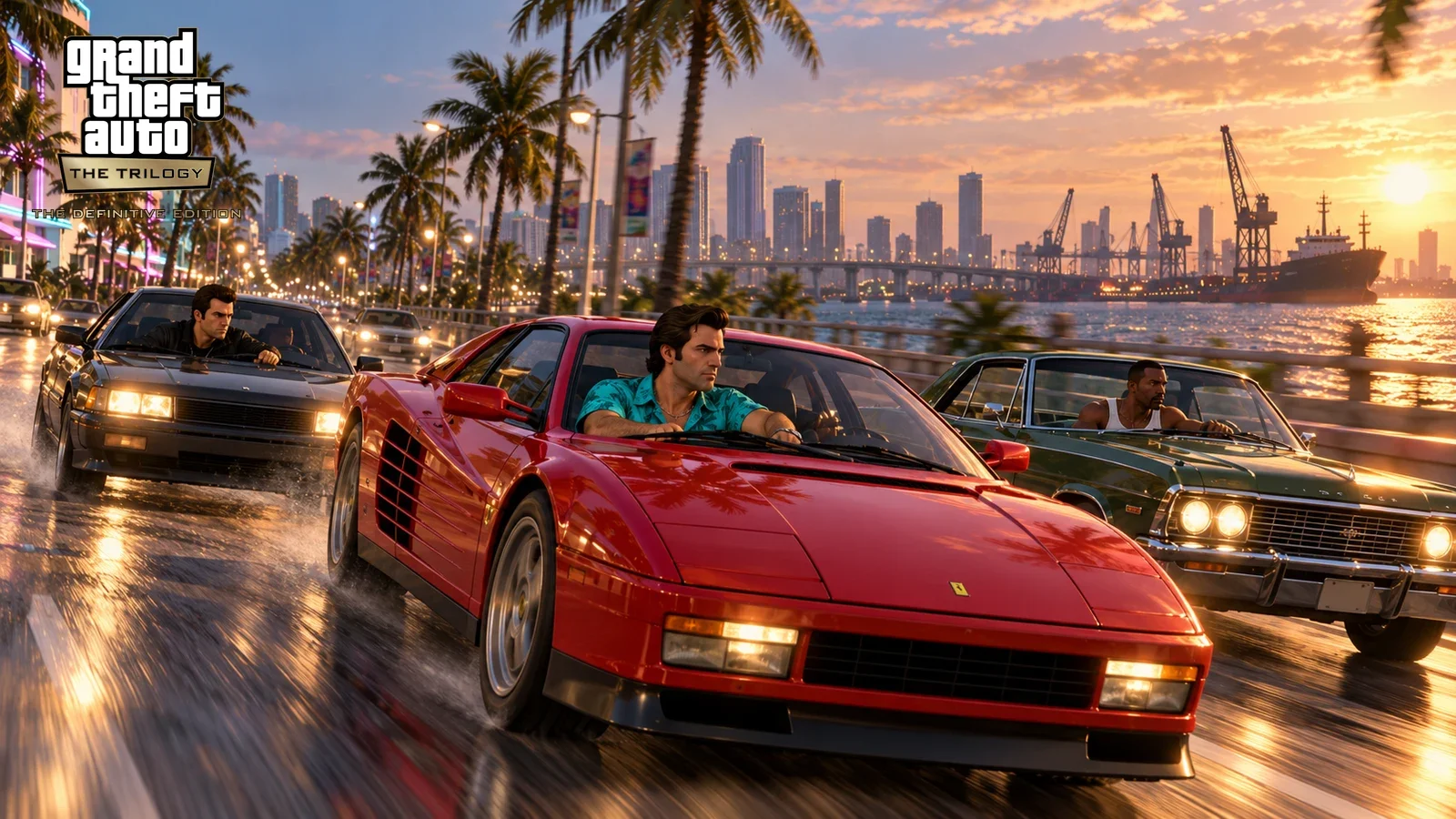
Porting and remastering also add separate teams. The 2021 Definitive Edition is not a new 2002 Rockstar North release, and the mobile anniversary adaptation should not be treated as an identical executable to the original PC version. Use the credits belonging to the edition being discussed.
The failed deal that starts Tommy's story
Tommy arrives in Vice City on business for Sonny Forelli. A drug transaction goes wrong, leaving him under pressure to recover the lost money and establish what happened. Lawyer Ken Rosenberg becomes an early ally, while contacts introduce Tommy to an expanding network of competing interests.
Lance Vance, Colonel Cortez, Ricardo Diaz, Kent Paul and Avery Carrington are central to that network. Sonny represents obligations that follow Tommy from Liberty City; local figures represent opportunities and threats in his new city. The character reference documents the cast and their relationships.
Tommy's personality is important to the structure. He is not merely a silent messenger between mission contacts. His responses make the question of loyalty visible: is he building somebody else's operation, or creating his own? That tension gives the property system a narrative purpose.
Vice City as a 1980s setting
The map combines beachside streets, commercial districts, residential areas, an airport and industrial spaces. Its identity is inspired by Miami, but it is a fictional city arranged for the game's missions and travel. The same place name returning in GTA VI does not make this the same map or a literal earlier version of every GTA VI building.
Period identity is distributed across many assets. A car's silhouette, a storefront sign and a radio selection can each communicate the era without stopping play for an explanation. That is why replacing a soundtrack or altering a visual detail can affect how a re-release feels even when the mission objectives remain familiar.
For navigation, learn the connections between the major islands and the locations of useful properties. A long journey can become much easier once a dependable route is familiar. The most memorable-looking street is not always the fastest approach to an objective.
Businesses and what 'assets' means here
In Vice City, 'assets' often refers to purchasable businesses, not the textures and 3D models used by developers. Businesses such as the Malibu Club, Print Works and Sunshine Autos have associated activities or requirements. They connect the story's ambition to the player's money and progression.
Buying a property and completing everything associated with it are different actions. If progress seems to stall, check what the owned business actually requires rather than assuming every purchase immediately finishes an asset chain. This distinction is more useful than following a list of property names without understanding their role.
Money therefore has a practical campaign function. Spending everything on optional purchases can leave fewer resources for the properties you want to pursue next. A first-time player benefits from planning purchases around the next intended activity rather than simply buying whatever appears first.
Vehicles, combat and exploration
Motorcycles and a broader range of aircraft help distinguish Vice City from GTA III. Travel options change the shape of a mission: a bike can thread through traffic but exposes Tommy, while air travel changes how the city is read from above. Boats provide another way to connect locations around the waterfront.
Tommy cannot swim in the original game, an important difference from later protagonists. Treating water as a safe escape route because it works in San Andreas is a costly assumption. The game's age is most noticeable when habits learned in newer GTA entries collide with its movement and mission rules.
Before a difficult objective, identify whether the challenge is aiming, navigation, timing or managing vehicle damage. Prepare for that specific problem. Repeatedly trying the same approach without changing the cause of failure is less useful than selecting a different route or transport option.
Editions and the right guide to use
Vice City began on PS2, followed by PC and Xbox releases. Anniversary mobile ports and later console availability expanded access, while the Definitive Edition provides a separate remastered version. Historical availability is not a guarantee that every old release remains on sale in every territory.
The original PC game uses typed cheat words; console editions use button sequences. Modern remaster controller mappings require attention, especially on Xbox. There is no ordinary built-in Vice City money code equivalent to San Andreas' health-and-cash cheat; see the documented distinction in PC Gamer's code reference.
Use our Vice City cheat guide for inputs and save precautions, and Vice City Stories for Victor Vance's earlier adventure. For collection differences, see the Definitive Edition guide.
Sources & verification
Sources last verified on . This article covers published information, not hands-on testing.
Editorial & update notes
AI-assisted research and writing based on the linked references. This is not a hands-on review. Images are labelled AI-generated illustrations, not gameplay screenshots.