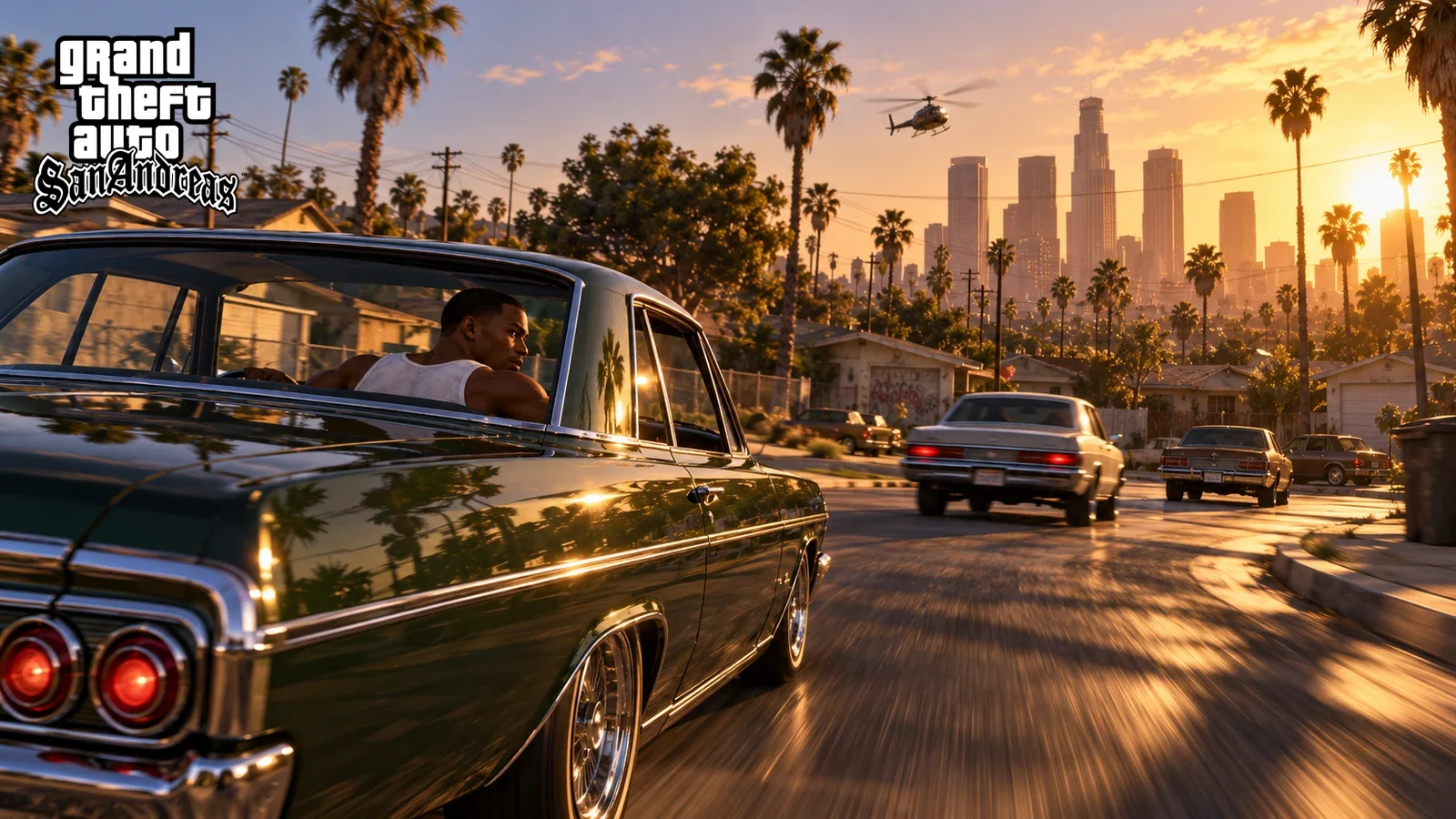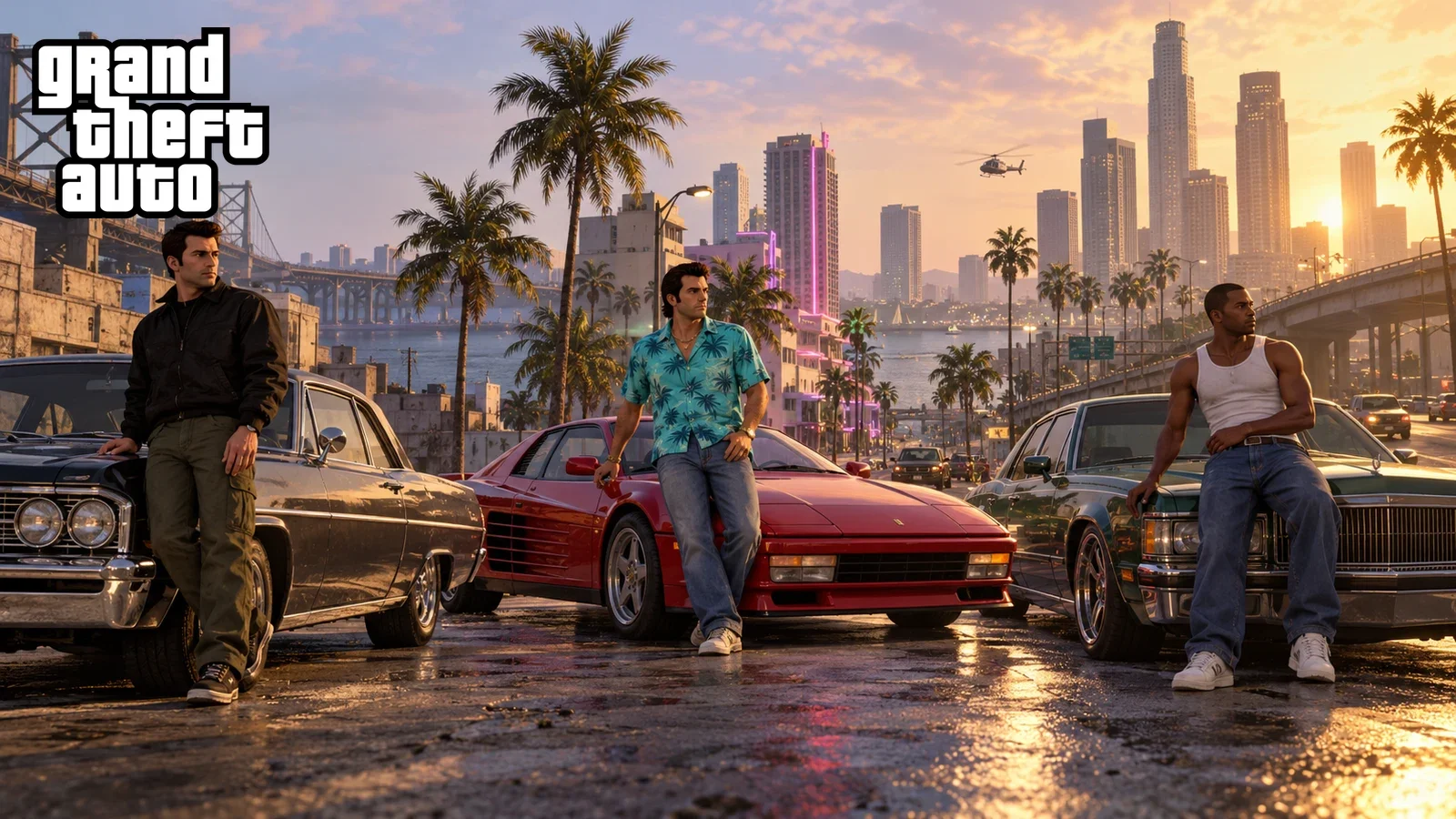
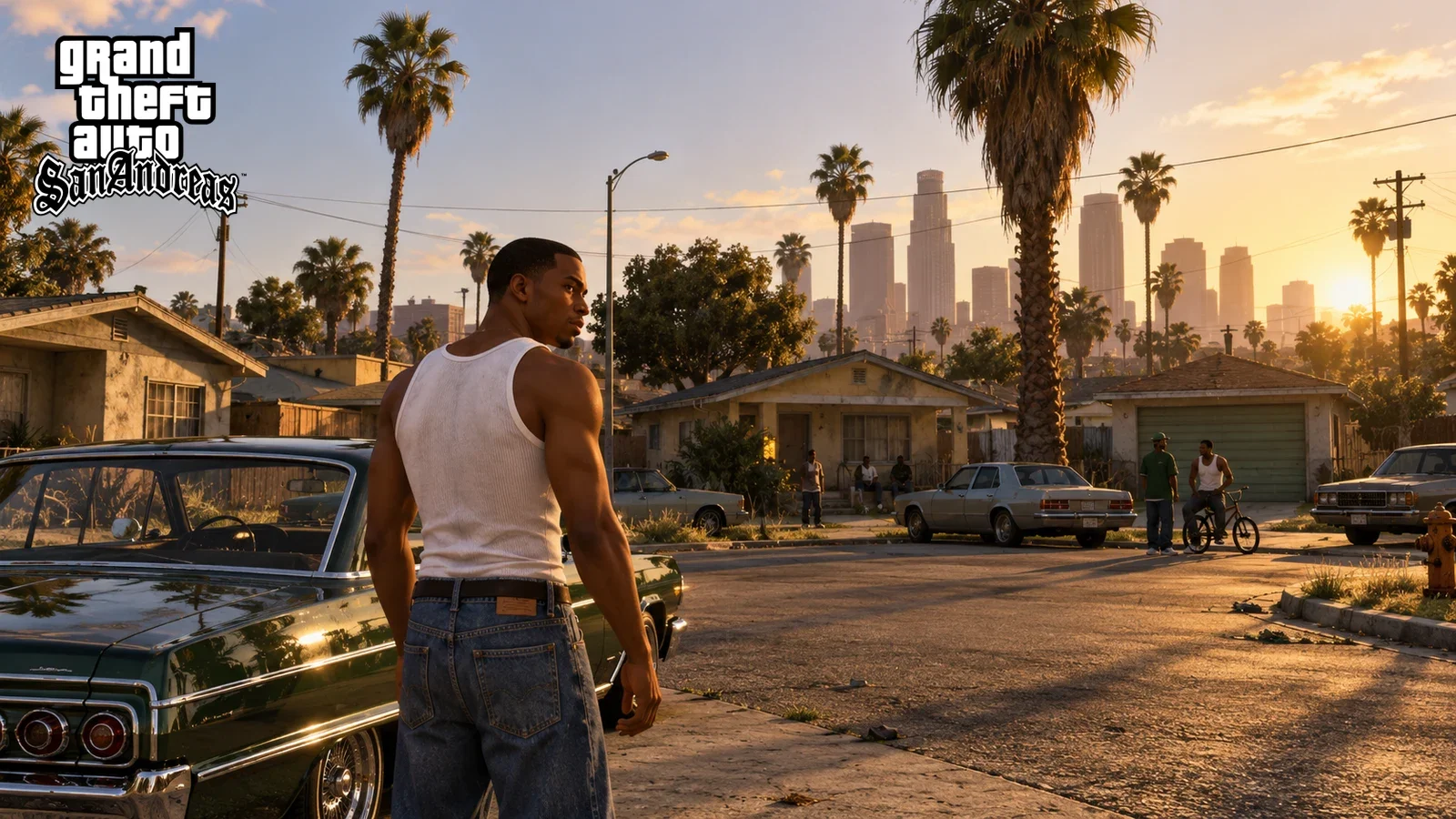
Grand Theft Auto: San Andreas expands the series from a single-city criminal ascent into a journey across a fictional state. Carl Johnson returns to Los Santos because of a family tragedy, then finds himself pulled through conflicts that extend well beyond his old neighborhood. The geography and the protagonist's changing circumstances develop together.
Released in 2004 and set in 1992, San Andreas combines a family story with a wide range of activities and character systems. This guide explains the major elements without revealing the late-game betrayals or ending.
Rockstar North and the credited development team
Rockstar North developed San Andreas and Rockstar Games published it. Leslie Benzies is credited as producer; Aaron Garbut as art director; Dan Houser, James Worrall and DJ Pooh contributed writing. The official PS2 manual provides the release's production credits and contemporary documentation.
Those names describe selected roles in a much larger team. The change in scale required work across city construction, countryside, vehicles, characters, animation, missions, audio and interface design. It would be misleading to attribute the entire game to a single writer or executive.
Later mobile adaptations and the Definitive Edition involved different production work. Preserve the original team's credit while recognizing that a port's controls, interface and presentation may be the responsibility of additional developers. A remaster credit is not evidence that the same studio created the 2004 game.
CJ's return and the opening conflict
Carl 'CJ' Johnson comes home after his mother's murder. His family and old friends are struggling, and corrupt officers quickly put him under pressure. Rockstar's official game description frames the campaign around saving his family and regaining control of the streets.
Sweet is CJ's brother and a central voice in the neighborhood's expectations. Kendl is his sister; Cesar Vialpando becomes an important connection beyond Grove Street. Big Smoke and Ryder belong to the familiar circle CJ returns to. Officers Frank Tenpenny and Eddie Pulaski represent the coercive power of the police within the story.
The expanding cast includes Wu Zi Mu, known as Woozie, and the eccentric conspiracy-minded Truth. Their roles help the campaign move into different regions and activities. These are introductions, not a complete account of their later decisions. A separate character reference is useful for readers who want fuller biographies and do not mind spoilers.
Three cities and the countryside between them
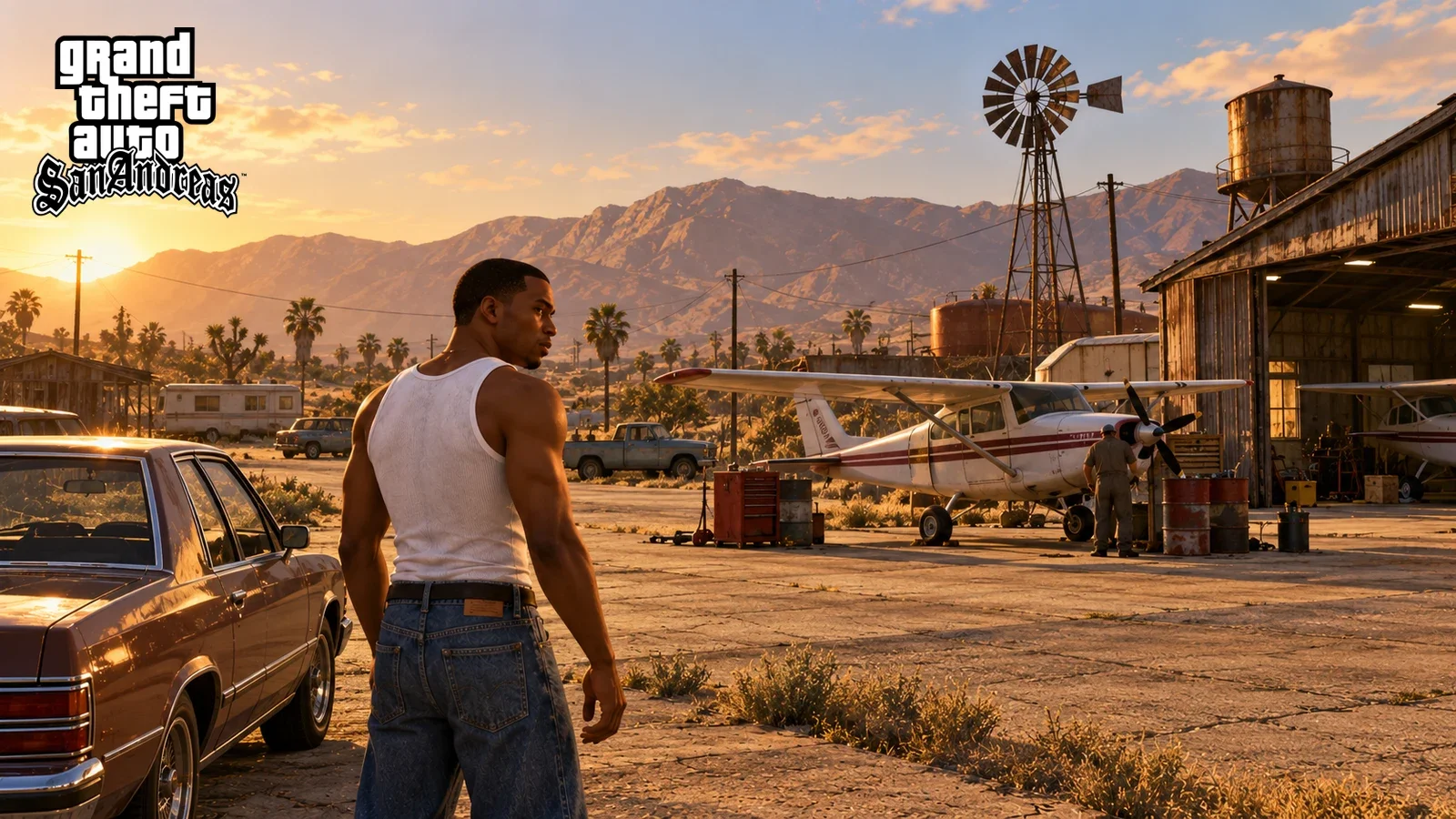
Los Santos, San Fierro and Las Venturas give the state three distinct urban centers. Rural areas, desert and small settlements connect them. The space between cities is part of the experience rather than a loading-screen abstraction.
This changes the meaning of a vehicle choice. A short urban trip, a mountain road and a long desert crossing create different demands. Learning how a bike, car or aircraft behaves can be more valuable than judging it by appearance alone. The same map supports different experiences depending on whether the player stays near home or travels across the state.
San Andreas is a fictional state, not a geographically accurate model of California and Nevada. Los Santos also returns in GTA V with a substantially different map. Comparing names is useful for identifying inspiration; it is not a reliable way to transfer directions from one game to another.
Character development beyond the mission list
CJ can change clothes and hairstyle, develop physical characteristics, and improve skills through activities. Swimming, cycling and a wider variety of transport broaden what the player can do between story objectives. These systems make the protagonist's routine part of the game, rather than treating every non-mission moment as empty travel time.
For a beginner, it helps to learn one system at a time. A clothing purchase, a driving challenge and a weapon skill increase do different things. Treating every statistic as equally urgent can turn an open-world game into unnecessary administration. Prioritize the capability that addresses the obstacle you are actually facing.
Gang territory is another distinct system. It ties combat to ownership of parts of the city, but it is not identical to GTA 2's gang-respect structure or Vice City Stories' business empire. The labels sound similar while the decisions and progression rules differ.
Missions, side activities and planning a playthrough
The main campaign moves through neighborhood disputes, rural jobs, urban contacts and larger operations. Side activities include vehicle services, schools, races, collectibles and other challenges. Finishing the story and reaching the game's full completion target are different goals.
If you want to experience the story first, avoid treating every optional marker as a prerequisite. If you want a completion run, track activities consistently and preserve clean saves. This is particularly important if you also want to experiment with cheat codes, because changing the world's behavior can make a mission much harder to finish.
Mission preparation should be specific. A driving objective calls for route knowledge and a suitable vehicle; a firefight calls for health, armor and a sensible approach. A guide that says only 'get better weapons' overlooks objectives where the real challenge is timing or positioning.
Original, mobile and Definitive Edition versions
San Andreas began on PS2 and later appeared on PC and Xbox. Subsequent mobile-derived releases and the 2021 Definitive Edition form separate branches of its release history. A version running on an Xbox One through compatibility is not automatically the same game build as the Definitive Edition sold for that console.
That distinction matters for controls and cheat sequences. Original Xbox instructions can refer to Black and White buttons; later layouts use bumpers and triggers differently. Mobile touch controls also do not imply that a built-in cheat keyboard exists in every edition.
The San Andreas cheat guide separates those cases and explains why the famous HESOYAM code is not interchangeable with a Vice City money cheat. The Definitive Edition article covers the remastered collection, while our GTA V guide explains the later return to Los Santos.
Sources & verification
Sources last verified on . This article covers published information, not hands-on testing.
Editorial & update notes
AI-assisted research and writing based on the linked references. This is not a hands-on review. Images are labelled AI-generated illustrations, not gameplay screenshots.