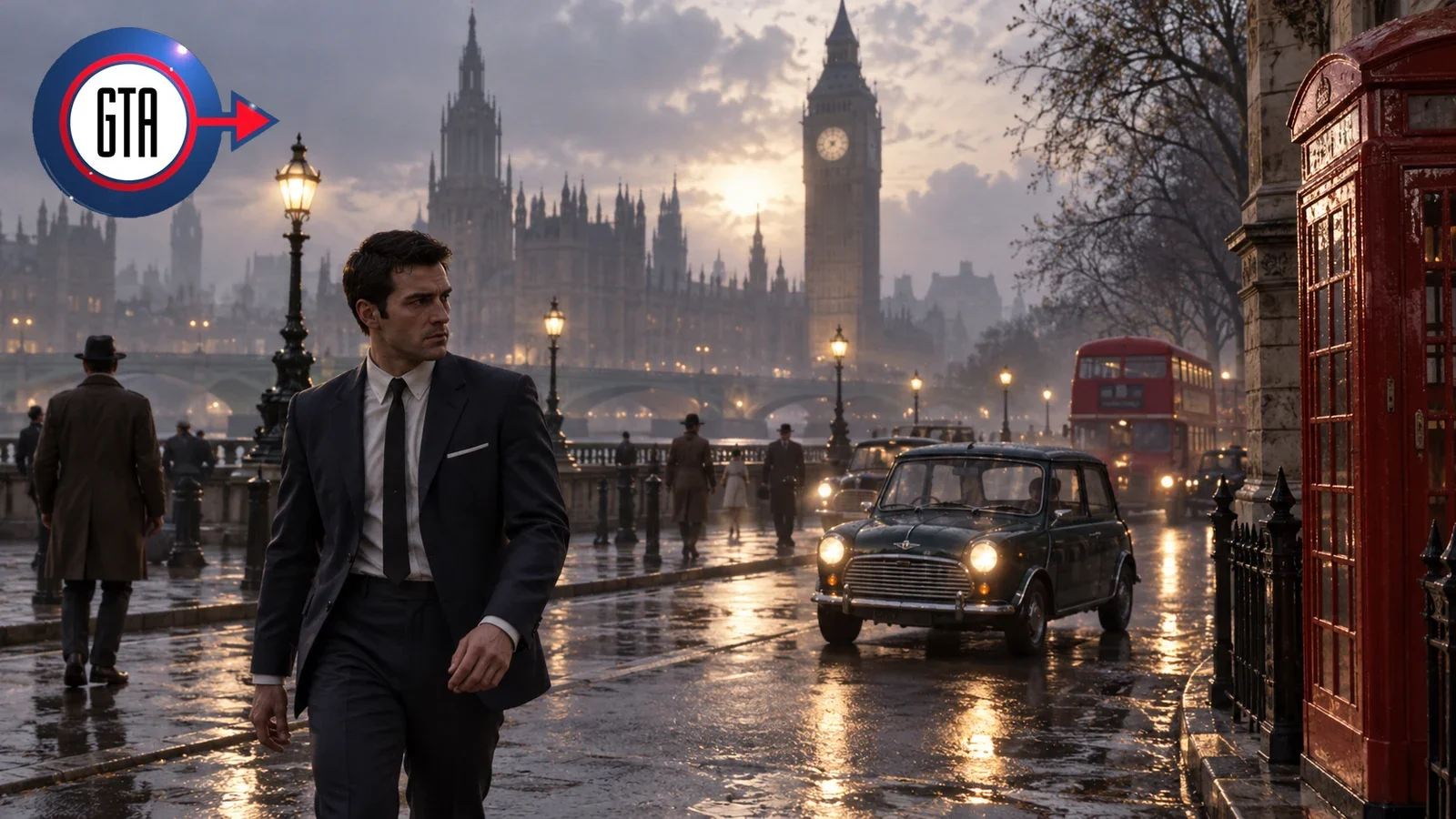
GTA London 1961 is the easily missed second London mission pack. It revisits the British setting eight fictional years before London 1969, while both releases belong to 1999 in real-world release history. It is a smaller add-on, so its importance comes from what it changes and how it fits into the original GTA, rather than from the scale of a modern standalone sequel.
This guide separates three questions that are often confused: when the story happens, when the software was released, and what software it requires. Keeping those answers separate makes the rest of the catalogue much easier to understand.
What exactly is London 1961?
London 1961 was distributed as a free downloadable PC expansion. It requires the relevant original GTA and London 1969 installation; it is not a self-contained replacement for either. The historical game reference records its PC-only status and downloadable format.
There was no official PlayStation release of this mission pack. A guide filed under a PlayStation section, an emulator video or a fan-made conversion should not be used as evidence that a commercial PS1 version existed. Similarly, playing a PC program through a compatibility layer on another device does not establish an official mobile edition.
Developers and crediting the London team
The London mission packs are associated with Rockstar Canada, later Rockstar Toronto, and the original GTA technology came from DMA Design. Historical databases sometimes collapse these distinctions or use later studio names. The safest explanation preserves the difference between the base game's creators and the team responsible for the expansion.
The London production credits include Greg Bick, Gary J. Foreman, Kevin Hoare, Ray Larabie and Blair Renaud; Dan Houser contributed the screenplay for the London project. These names are useful for understanding the project lineage, but a role on London 1969 should not be silently re-labelled as a newly verified role on every subsequent build. Our London 1969 credits source is explicitly edition-labelled for that reason.
For London 1961, the development attribution is more useful than inventing a lengthy staff list from later Rockstar games. The work builds upon a compact, shared production foundation. Its limited size does not justify attributing it to whichever modern Rockstar studio is most familiar.
Story setting and characters
The earlier year makes London 1961 a chronological prequel to London 1969. It remains within the same overhead London branch of GTA, not the later Liberty City continuity of GTA III. The cast and selectable identities are connected to the London setting rather than to Claude, Tommy Vercetti or CJ.
The important context is the established British criminal world: jobs arrive through contacts and the player acts within competing local interests. For the named playable identities and principal figures, see the London 1969 character section. This keeps shared background in one place while avoiding the misleading impression that London 1961 introduces an entirely new cinematic ensemble.
The game's sparse storytelling leaves much of the experience to the missions themselves. A player looking for a detailed personal biography, voiced emotional arc or multiple modern endings should adjust expectations. The story supplies a framework for the action rather than functioning as a feature-length drama between driving sections.

How to approach the additional missions
Treat this as follow-on material for someone already comfortable with the London controls and city. The useful skills are route memory, vehicle handling and close reading of instructions. The same overhead perspective that makes the street grid legible can make high-speed reactions difficult when a turn appears near the edge of the screen.
Before repeating a failed objective, identify its actual failure point. Did you lose the route, damage the vehicle, misunderstand the task, or spend too much time dealing with pursuit? Repeating the same route faster will not solve an instruction mistake. This diagnostic approach is especially useful in older games that provide less explicit recovery guidance.
Separate free exploration from a serious progress attempt. Use exploration to learn road connections and identify useful services. That turns later missions into execution problems rather than a combination of navigation research and time pressure. It also makes the reused setting feel purposeful: existing map knowledge becomes a resource.
Historical installation and modern compatibility
Because this is an add-on to an old PC release, installation instructions depend on the underlying edition. A guide written for the original retail files should not be assumed to work unchanged with every later compilation. Check the exact base-game release and accompanying documentation before following historical file-copy instructions.
This article does not provide a game download or claim that an abandoned official download URL still works. A file being old, or once having been offered free, is not proof that every mirror is complete or authentic. For a preserved installation, keep the original files and any configuration changes distinguishable so that troubleshooting remains possible.
Cheat support and catalogue placement
London 1961 uses the London branch's name-entry approach to cheats, not GTA IV's phone dialler or GTA V's PC console. Our London 1961 cheat reference explains the documented PC codes and the limits of the available evidence.
In release order, place the London packs between the original GTA and GTA 2. In story chronology, London 1961 precedes London 1969. In a buying guide, describe it as a dependent PC add-on. Those three classifications answer different reader needs, and none requires pretending it is a full modern sequel.
Sources & verification
Sources last verified on . This article covers published information, not hands-on testing.
Editorial & update notes
AI-assisted research and writing based on the linked references. This is not a hands-on review. Images are labelled AI-generated illustrations, not gameplay screenshots.