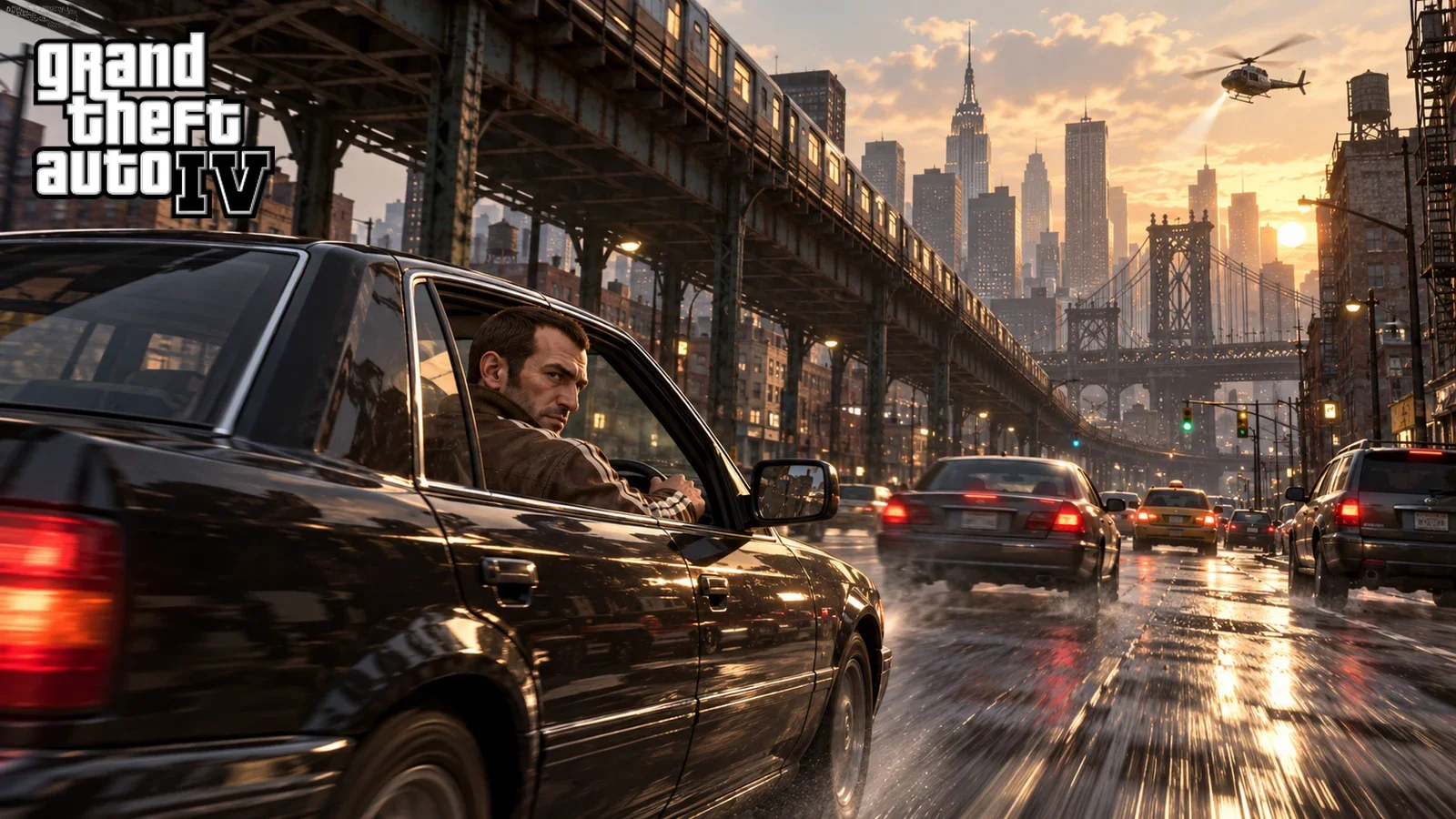
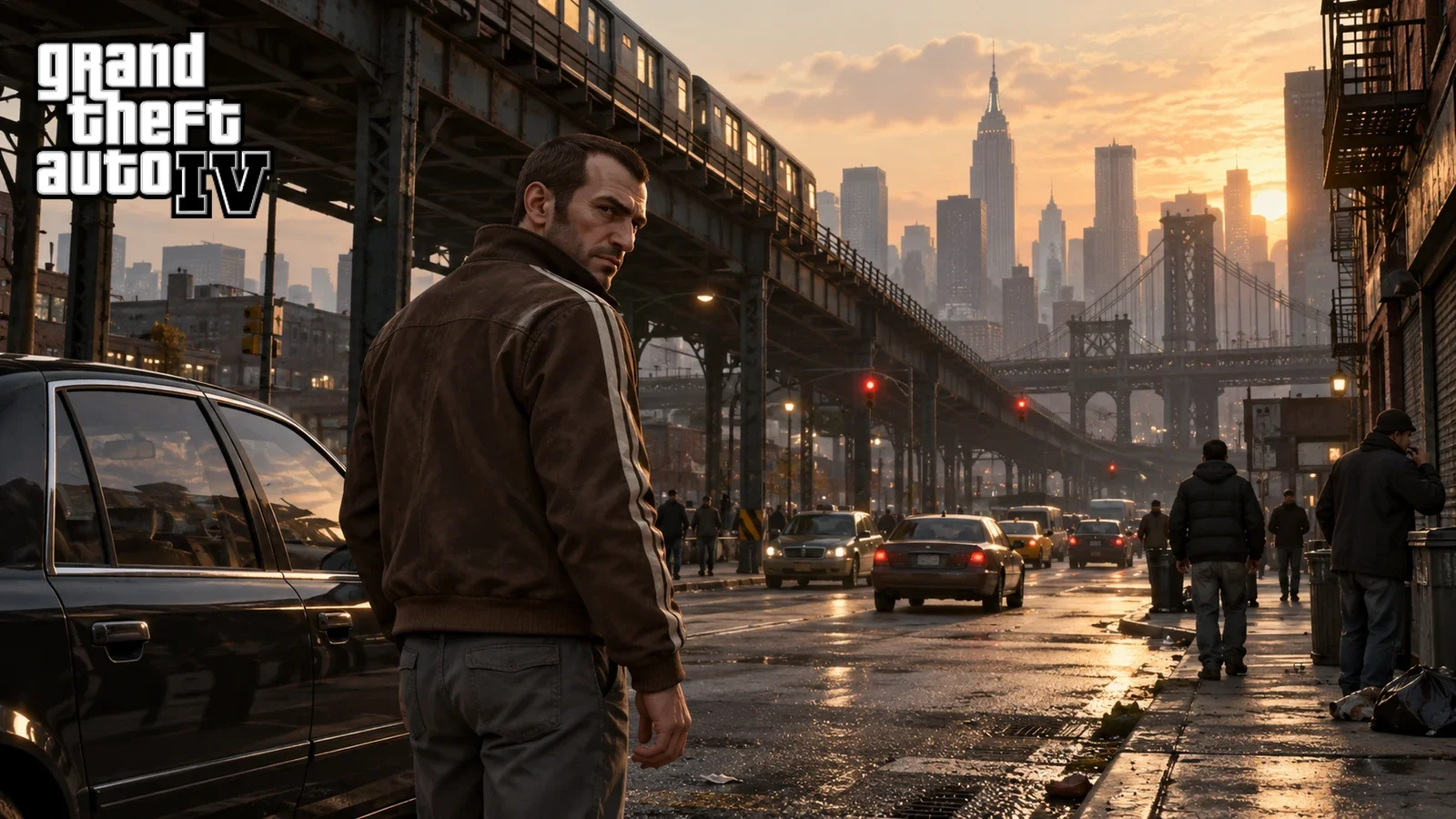
Grand Theft Auto IV introduces Niko Bellic to a newly imagined Liberty City. He arrives looking for a different life, but his past and his cousin Roman's difficulties quickly complicate that hope. The city promises opportunity while repeatedly showing how money, connections and violence shape access to it.
The game launched in 2008. This guide covers Niko's campaign, with introductory story details, and explains how it relates to The Lost and Damned, The Ballad of Gay Tony and the Complete Edition. It does not reveal the ending choices.
Rockstar North and the people behind GTA IV
Rockstar North developed GTA IV, published by Rockstar Games. The launch announcement records the April 29, 2008 release for PS3 and Xbox 360. PC followed later that year.
The official PS3 manual contains the production and performance credits. Leslie Benzies is associated with production, Aaron Garbut with art direction, and Dan Houser and Rupert Humphries with the writing. Michael Hollick performs Niko Bellic; that performance credit is distinct from the writing and development roles.
GTA IV's development should be understood as a large collaboration. World construction, vehicle behavior, character animation, mission scripting and audio all influence how the city feels. Naming selected leaders helps explain responsibilities, but it does not reduce the game to the work of those few individuals.
Niko, Roman and the expanding cast
Niko's cousin Roman is the first major personal connection in Liberty City. Roman's descriptions of success do not match the reality Niko encounters, creating an immediate contrast between expectation and circumstance. Their relationship gives the opening more than a simple sequence of criminal assignments.
Little Jacob, Brucie Kibbutz and Patrick 'Packie' McReary become important contacts. Mikhail Faustin and Dimitri Rascalov draw Niko into another set of dangerous relationships, while figures such as Ray Boccino and Jimmy Pegorino connect him to wider criminal interests. The character index provides links to fuller biographies.
The cast is deliberately broader than a list of mission bosses. Friends, relatives and acquaintances occupy different parts of Niko's life. The phone helps bring those relationships into ordinary play rather than restricting every interaction to a mission-opening cutscene.
A new Liberty City, not GTA III's map
Broker, Dukes, Bohan and Algonquin form the city's borough structure, with Alderney across the water. This is a reimagined setting, not an HD texture pack applied to GTA III's Portland, Staunton Island and Shoreside Vale.
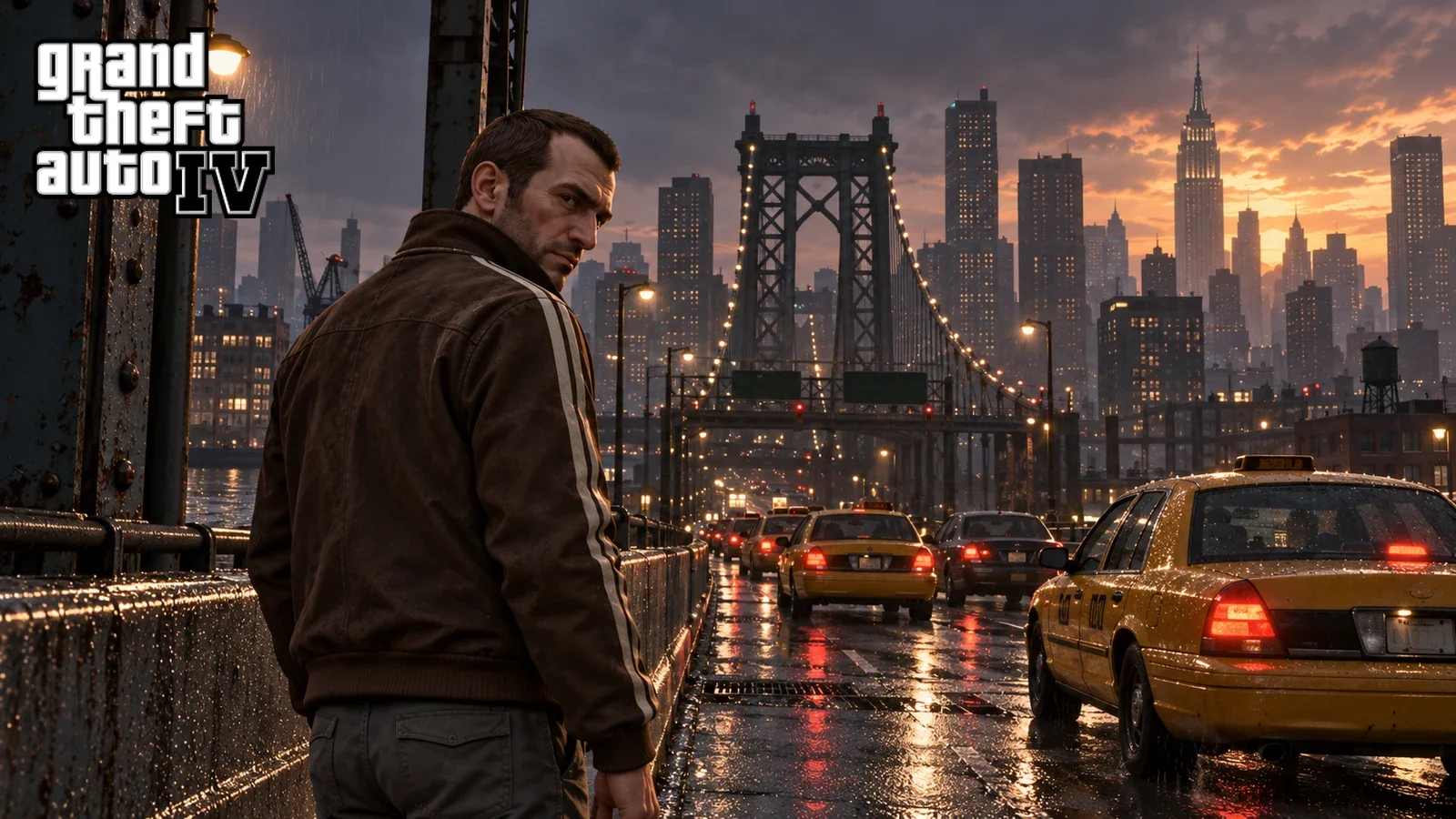
The street network, bridges, dense neighborhoods and waterfronts shape travel. A chase may be decided by knowing a turn, avoiding a congested approach or reaching a route with several exits. The map is therefore more than scenery between conversations.
Visual inspiration and story continuity are separate: sharing a city name does not make two maps identical. Both versions draw on New York, but a building name or recurring brand does not establish identical geography. GTA IV belongs to the HD-era reinterpretation of the setting.
Driving, cover and the phone
Vehicle handling emphasizes weight and momentum differently from the earlier games. Braking before a corner and planning room to turn can be more effective than treating every car as if it pivots instantly. This is a description of the game's design, not a claim that NextPlayIntel has benchmarked its physics.
Combat includes a cover system, changing how a firefight can be approached. Cover is useful when it gives a clear view and an escape route; simply attaching to the nearest object does not guarantee a safe position. Mission context and enemy angles still matter.
The mobile phone organizes calls, messages and several game functions. It also becomes the interface for built-in cheat numbers. That makes GTA IV different from the older games' typed words and button strings, and from GTA V's combination of input methods.
Story progression and optional life in the city
Main missions develop Niko's relationships and conflicts. Optional activities and social interactions provide another pace, allowing the city to be experienced between major events. Finishing the narrative and completing every tracked activity are separate objectives.
A story-first player can focus on understanding the contacts and immediate stakes. A completion-focused player benefits from tracking optional tasks and keeping saves at meaningful points. Neither approach requires pretending that the game offers every activity found in San Andreas; GTA IV deliberately has a different set of priorities.
The ending involves choices and consequences. This guide leaves them unspoiled. If following a walkthrough, check whether its headings reveal outcomes before scrolling through the late-game sections.
Base game, episodes and Complete Edition
The Lost and Damned follows Johnny Klebitz; The Ballad of Gay Tony follows Luis Lopez. Their events intersect with Niko's, but each has its own protagonist, missions and tone. The Rockstar Store listing identifies the Complete Edition as containing all three stories.
Episodes from Liberty City is a different package: it collects the two episodes. The title does not mean that Niko's full campaign is included. Likewise, an old review of a console multiplayer mode should not be treated as proof that the current PC Complete Edition retains the same online services.
Platforms and cheat guidance
The original platform families are PS3, Xbox 360 and PC. Backward compatibility can allow a historical console release to run on newer hardware, but that does not make it a native remaster. Confirm the actual edition before following installation, performance or online-feature advice.
Our GTA IV phone-code guide covers documented numbers and achievement considerations. The Lost and Damned and Ballad of Gay Tony guides explain the additional stories, while the Episodes and Complete Edition comparison helps identify which package contains what.
Sources & verification
Sources last verified on . This article covers published information, not hands-on testing.
Editorial & update notes
AI-assisted research and writing based on the linked references. This is not a hands-on review. Images are labelled AI-generated illustrations, not gameplay screenshots.